

Is a Whole House Water Filter Worth It for Renters?
Last Updated: November 21, 2026
Quick Summary
For most renters, a whole house water filter is not worth it, because it usually needs plumbing work that a landlord must approve and that can leave costs behind at move-out. A portable jug or bench top filter, which needs no plumbing, is usually the better fit for a rented flat.
- Whole-house systems usually connect to the mains line, which typically needs your landlord's written consent.
- Include removal and restoration costs in your break-even test, not just the upfront price.
- The BIO 500 MAX 7 Litre Bench Top Water Filter costs £349.00 and needs no plumbing.
- Agree in writing who pays for installation, cartridges and removal before any work begins.
- Photograph the pipework before and after installation to protect your deposit.
Table of Contents
- Why Renters Ask About Whole House Water Filters
- Best Water Filter for Renters: Portable and No-Plumbing Options
- Whole House Water Filter vs Point-of-Use Filters
- Whole House Water Filter Installation Cost and Long-Term Value
- Getting Landlord Permission to Install a Water Filter
- No-Plumbing Water Filter for Renters: What Works Without Drilling
- Choosing the Right Filter for Your Next Move
- Frequently Asked Questions
Most renters who think about a whole house water filter stop at the same question: is it worth paying for a system you cannot leave behind when you move out? For a flat in the UK, the honest answer depends on your lease, your water and how long you plan to stay. This guide from Waters Co works through those trade-offs, with the numbers and the renter-specific details that most buying guides skip.
Why Renters Ask About Whole House Water Filters
Renters ask this question because the usual advice assumes you own the plumbing. Whole-house systems usually sit on the mains line where it enters the property, which normally means cutting into pipework. Most tenancy agreements do not allow that without the landlord's written consent.
The concern is not only about cost. Many renters worry about tap water quality in their area and want to reduce exposure to chlorine, fluoride or metals without committing to a permanent installation.
Best Water Filter for Renters: Portable and No-Plumbing Options
If you rent, the simplest route is a system that needs no plumbing at all. The AceBio+ 1.0 Litre Alkaline Mineral Water Filter Jug at £125.00 is a gravity-fed jug that needs no electricity or tap connection. The product listing states it filters chlorine, heavy metals and fluoride, and that a filter set lasts up to 4,800 litres or up to 24 months, depending on your water supply and daily use.
The MyWaterJug 1.5L Water Filter at £64.99 is the lower-cost option. Its listing says each filter lasts up to 300 litres or up to 3 months, and the jug is designed as a portable solution that can move with you.
Portable jugs are the easiest choice for renters because they pack into a box and come with you. The trade-off is volume and refill frequency. A jug works well for drinking water but will not supply every tap in the flat.
The products below are the ones the article names for renters, with the figures it states for each.
| Product | Price | Filter life stated |
|---|---|---|
| AceBio+ 1.0 Litre Alkaline Mineral Water Filter Jug | £125.00 | Up to 4,800 litres or 24 months |
| MyWaterJug 1.5L Water Filter | £64.99 | Up to 300 litres or 3 months |
| BIO 500 MAX 7 Litre Bench Top Water Filter | £349.00 | Up to 12,000 litres or 18 months |
Price
Whole House Water Filter vs Point-of-Use Filters
A whole-house system treats all the water entering the property. A point-of-use filter, such as a jug, an under-sink unit or a bench top dispenser, treats only the water you draw from that point.
For most renters, point-of-use is the better fit. You filter the water you actually drink and cook with, and you avoid the plumbing work a whole-house system demands. Whole-house treatment makes more sense when you want filtered water at every tap, including the shower, and when you control the property. For a side-by-side look at the alternative system types, see the comparison of five systems.
The BIO 500 MAX 7 Litre Bench Top Water Filter at £349.00 sits in between. It needs no plumbing, so you can take it with you, but it gives a larger batch of filtered water than a jug. The listing states a filter set lasts up to 12,000 litres or up to 18 months.
Whole House Water Filter Installation Cost and Long-Term Value
Whole-house systems are a significant purchase to fit to a rented property, so cost and reversibility matter. The main cost lines are the equipment, the plumbing work, the cartridges, and any exit cost if you move or must restore the pipework.
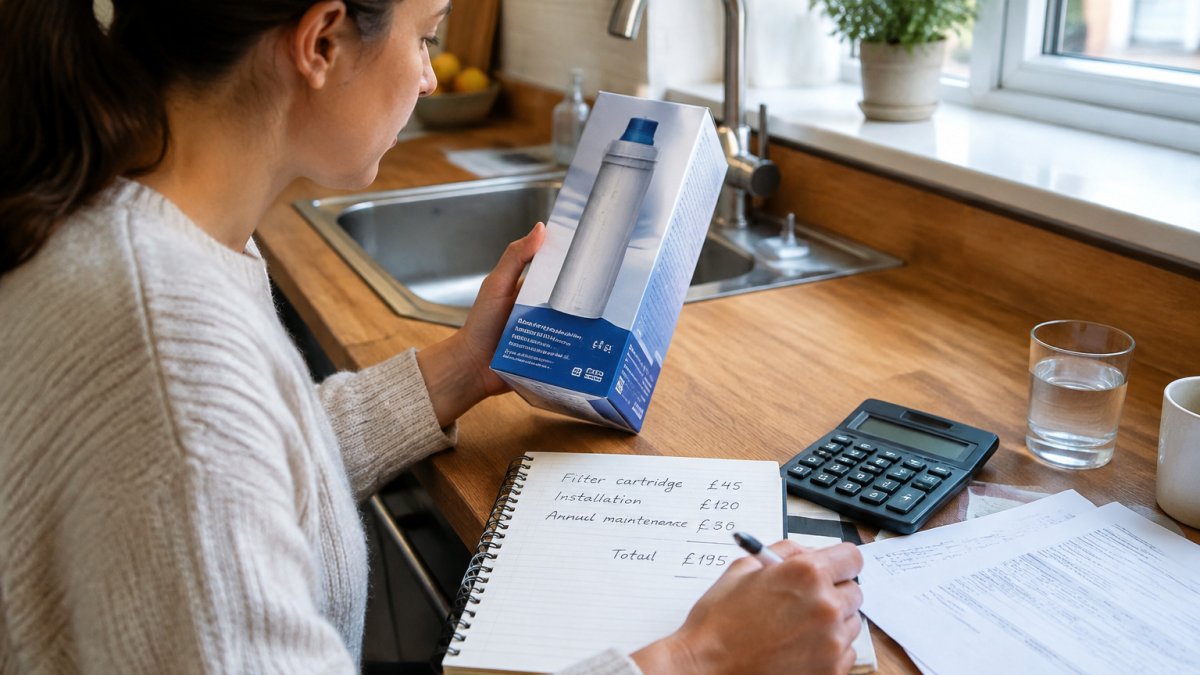
On equipment, a bench top dispenser such as the BIO 500 MAX 7 Litre Bench Top Water Filter at £349.00 is one no-plumbing option to compare against whole-house systems, which are priced separately by their suppliers. On installation, a qualified plumber is normally needed to cut into the mains line and fit isolation valves, and the fee varies with property age, pipe material and access. Get two or three written quotes before committing to the work.
On cartridges, ask the supplier for the replacement interval and price for every stage before you buy, so you can work out the full annual running cost.
On exit cost, if the landlord wants the system removed at the end of the tenancy, you may need to pay for removal and restoration as well as installation. If the landlord agrees to keep it, the equipment stays with the property.
Break-Even Calculator for Renters
The break-even test is not simply upfront cost divided by annual saving. It must include the exit cost and the resale or transfer value of the equipment. Work through it in this order:
- Total upfront cost = system price + plumber's installation fee + any making-good of pipework or cabinetry.
- Annual running cost = sum of every cartridge replacement price at its stated interval.
- Annual avoided spend = what you currently pay for bottled water, jug cartridges or a subscription service over 12 months.
- Exit cost = removal and restoration quote if the landlord requires it, or £0 if the system stays and you accept the loss.
- Recoverable value = resale value of the equipment if it can be removed intact and sold, otherwise £0.
- Net cost over the tenancy = (upfront + annual running × years) − (annual avoided × years) − recoverable value + exit cost.
- Cost per month = net cost ÷ (years × 12).
Compare that monthly figure with the cost of a jug or bench top system. The arithmetic depends heavily on the length of the tenancy, the installation fee and whether a removal charge applies. Spreading installation and exit costs over a short tenancy raises the monthly cost, while a longer tenancy with the system left in place spreads the upfront cost further.
A break-even calculation that omits the removal and restoration quote will understate the true cost of a whole-house option.
The practical rule: if the net cost per month over your likely tenancy is higher than a bench top or jug system, the whole-house route is not worth it on money alone, it has to be justified by wanting filtered water at every tap, including the shower, which point-of-use cannot deliver. That makes the decision less about filtering in general than whether whole-house coverage is worth the added cost for your tenancy, a question framed by a guide on whole house water filters.
Getting Landlord Permission to Install a Water Filter
Permission is the gate every whole-house renter hits, and a vague "ask nicely" does not survive contact with a tenancy agreement. Treat it as a documented request with four parts: what will be installed, who will do the work, how it will be reversed, and who pays for what.
Read the lease first. Most tenancy agreements contain a clause on alterations, and the wording matters. Some prohibit any change to the plumbing without consent; others allow reversible improvements with consent not to be unreasonably withheld.
Make the request in writing. A short letter or email that names the system, the installer (with qualification, such as a Gas Safe-registered or suitably qualified plumber where relevant), the proposed date, the reversibility plan and the insurance position gives the landlord something to say yes to. Verbal approval is worth little if a deposit dispute arises later.
Agree who pays for what, in writing. The points to nail down are: who pays for installation; who pays for cartridge replacement during the tenancy; who pays for removal and restoration at the end; who is liable if the installation causes a leak or damage; and whether the system stays with the property or leaves with you.
Document the condition before and after. Photograph the pipework and surrounding area before the plumber starts and after the work is complete, and keep the installer's invoice and any warranty. This is the evidence that protects your deposit if the landlord later claims the work caused damage.
Check the position for your nation. The legal framework for repairs and alterations differs across the UK. The rules on repairs and alterations differ across the UK and depend on the tenancy terms and the law of the nation where the property sits.
Watch out: a landlord's verbal "yes" followed by a change of heart at checkout is the most common way renters lose deposit money on filter installations, put the agreement in writing and keep it.
If the landlord refuses, that is not a dead end. A bench top or jug system needs no consent at all, because it touches no pipework and leaves no trace. For most renters, the permission question is the moment the whole-house option stops being worth it.
No-Plumbing Water Filter for Renters: What Works Without Drilling
The strongest options for renters avoid drilling and plumbing entirely. These include jugs, bench top dispensers and gravity-fed units. The BIO 400 5.25 Litre Bench Top Water Filter at £329.00 is another example: it is easy to set up, needs no electricity or tap connection, and is compact in size.
Under-sink and faucet-mounted filters are common, but they usually require some installation, so check your tenancy before you buy one. A bench top or jug avoids that question altogether.
Choosing the Right Filter for Your Next Move
Moving is where many whole-house systems fail renters. A permanent installation stays with the property, so you either leave it behind or pay to remove it. A portable system goes with you.
When you choose, consider three things. First, can you take it with you without losing value? Second, will the filter fit your next kitchen? Third, what does a replacement cartridge cost, and can you buy it easily wherever you move? A jug or bench top dispenser answers all three questions. A whole-house system answers only one.
For many renters, a portable system avoids the permission and installation questions that a whole-house installation raises. If your tenancy is long and your landlord agrees, a whole-house system may be worth a closer look. Waters Co offers portable jugs and bench top systems, which you can consider against your own water use and budget.
Frequently Asked Questions
Can renters install a whole-house water filter?
Usually not without permission. A whole-house system needs a plumber to connect it to the mains supply, which is a permanent change to the property. Most tenancy agreements require written landlord consent before any plumbing work. Renters who want filtered water across the whole home often find a point-of-use system, such as an under-sink or countertop unit, easier to get approved and easier to remove when the lease ends.
Do you need your landlord's permission to install a water filter?
For anything that connects to the pipework, yes. Fitting an under-sink or whole-house unit alters the plumbing, so written consent is the safe route. Portable jugs and countertop filters that need no tools generally do not require permission. Check your tenancy agreement first, then ask the landlord in writing, describing the system, the installer and how it would be removed at the end of the tenancy.
Is a whole-house water filter worth the cost in a rental?
It depends on how long you will stay and how much filtered water you use. A whole-house system carries a higher upfront cost and an installation fee, and it may be lost when you move. Work out the total cost over your expected stay, including cartridge replacements, and compare it with the prices of portable options such as the AceBio+ 1.0 Litre Alkaline Mineral Water Filter Jug (£125.00) or the BIO 400 5.25 Litre Bench Top Water Filter (£329.00).
What happens to a water filter when you move house?
Portable jugs and bench top units can go with you when you move. A system installed under the sink or on the mains needs disconnecting and may stay with the property, meaning the cost is effectively lost. Before installing anything, agree in writing with your landlord who owns the unit and whether it must be removed at the end of the tenancy.
