

APEC Water Filter Alternative Options: 5 Systems Compared
Table of Contents
- Why Look for an APEC Water Filter Alternative
- Comparison Table: Five APEC Water Filter Alternative Options
- Reverse Osmosis Alternatives That Skip the Plumbing
- APEC vs Waterdrop RO Systems: What the Design Difference Means
- Best Water Filter Pitchers for Renters and Small Kitchens
- Reverse Osmosis Water Filter Maintenance vs Gravity Systems
- Total Cost of Ownership Over Five Years
- Conclusion
- Frequently Asked Questions
Last Updated: October 18, 2026
Why Look for an APEC Water Filter Alternative
Plumbing restrictions, landlord rules, and under-sink installation push many households to look for an APEC water filter alternative.
At Waters Co, we hear three common objections: "I can't drill through my worktop", "I don't want to lose the cupboard under the sink", and "I want to take my water with me when I move".
The trade-off is honest: you fill them by hand and you wait for water to filter through. For most households, that is a fair exchange for zero installation and a lower upfront cost.
Comparison Table: Five APEC Water Filter Alternative Options
The five systems below cover the practical range: two portable jugs and three bench-top gravity filters. All are multi-stage, need no plumbing, and run without a plumber, landlord's permission, or spare cupboard.
| System | Capacity | Price | Filter Life | Cartridge Type | Best For |
|---|---|---|---|---|---|
| ♥MyWaterJug 1.5L | 1.5 litres | £64.99 | Up to 300 litres (3 months) | Proprietary 7-stage cartridge | Budget buyers, single person |
| AceBio+ 1.0L Jug | 1.0 litre | £125.00 | Up to 4,800 litres (24 months) | Proprietary 10-stage filter set | Travel and small households |
| BIO 400 5.25L | 5.25 litres | £329.00 | Up to 12,000 litres (18 months) | Proprietary 13-stage cartridge set | Families, daily kitchen use |
| BIO 500 5.25L | 5.25 litres | £329.00 | Up to 12,000 litres (18 months) | Proprietary 13-stage cartridge set | Same as BIO 400 in black |
| BIO 500 MAX 7L | 7 litres | £349.00 | Up to 12,000 litres (18 months) | Proprietary 13-stage cartridge set | Larger households, offices |
Two things stand out: the jugs cost a fraction of the bench-top units but need cartridges far more often, and the BIO 400 and BIO 500 are the same unit in different colours, so choose on finish, not specification. The MAX simply adds capacity.

Matching an alternative to a specific APEC model
Most buyers arrive here because they own, or were about to buy, a particular APEC system. This table maps common APEC configurations to the closest no-plumbing alternative.
| APEC-style system you were considering | Typical constraint | Closest alternative here | Why it fits |
|---|---|---|---|
| Under-sink RO with storage tank (e.g. RO-90 class) | Needs drain line, tank and cupboard space | BIO 400 or BIO 500 | Same multi-stage reduction of chlorine, fluoride, heavy metals and bacteria, no drain or tank |
| Tankless under-sink RO | Needs mains pressure and a permanent connection | BIO 500 MAX 7L | Larger stored capacity replaces on-demand flow for a family |
| Countertop RO | Needs electricity and a nearby socket | AceBio+ 1.0L | No power, 10 stages, two-year filter set |
| Portable or travel filtration | Small capacity, frequent cartridge changes | ♥MyWaterJug 1.5L | Lowest upfront cost, fridge-door size |
Replacement-filter compatibility and availability
Every system here uses proprietary cartridges, not standard housings. You cannot substitute a generic cartridge, and availability is controlled by the brand, so check cartridges are stocked in the UK before you buy.
A practical checklist before purchase:
- Confirm the cartridge model number and that it is listed as in stock from a UK supplier.
- Check the stated filter life in litres, not just months; a household of four will exhaust a 300-litre cartridge far faster than a single person.
- Ask whether the cartridge set is sold as one unit or as separate stages, because mixed sets change the running cost.
- Keep the reminder card or app notification active; gravity systems do not warn you when performance drops.
Filtration stages and what they remove
The BIO range runs 13 stages, combining a pre-filter membrane, silver-ionised coconut shell carbon, coral and silica minerals, ceramics, far infrared, and magnets. According to Waters Co's own product specifications, they reduce up to 99% of sediment, rust, bacteria, cysts, chlorine, heavy metals, fluoride, and odours.
Treat manufacturer figures as claims to verify, not independent test results. Ask for the contaminant-reduction data behind any "up to 99%" figure and check it covers the contaminant you care about; a system strong on chlorine may be weaker on fluoride.
Reverse Osmosis Alternatives That Skip the Plumbing
Reverse osmosis alternatives fall into four families: gravity-fed carbon block systems, jug filters, countertop units, and whole-house filtration. Only the first three suit a no-plumbing brief.
Gravity systems push water through a multi-stage cartridge stack using nothing but gravity.
Jug filters do a similar job in miniature: the ♥MyWaterJug runs 7 stages and the AceBio+ 10.
What you give up versus RO is the semi-permeable membrane and its very fine rejection of dissolved solids.
APEC vs Waterdrop RO Systems: What the Design Difference Means
APEC vs Waterdrop RO systems compares two plumbed designs that share the same constraint: a permanent water connection and a drain line.
Tankless designs save cupboard space and deliver water on demand but cost more upfront and depend on mains pressure.
Neither design solves the renter's problem. That is where a bench-top gravity filter differs fundamentally: no connection, no drain, no pressure requirement. You trade convenience of on-tap delivery for portability and zero installation.
Best Water Filter Pitchers for Renters and Small Kitchens
The best water filter pitchers for renters are compact, need no installation, and fit in a fridge door. Two options stand out for different budgets.
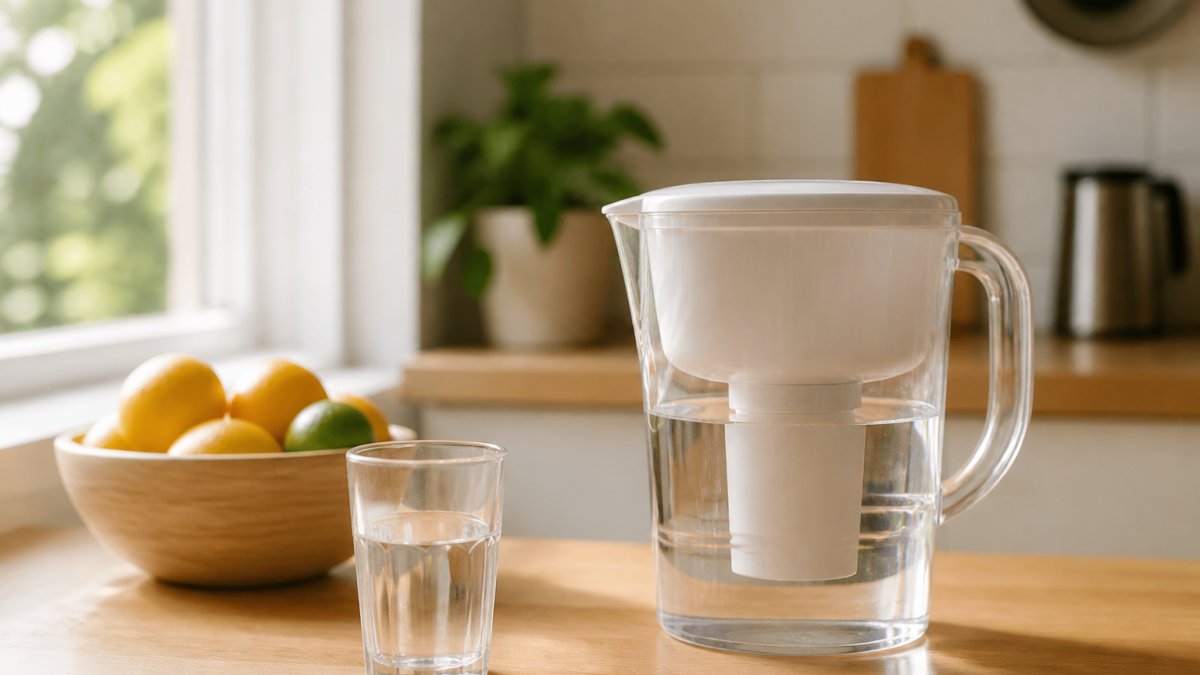
Step up to the AceBio+ 1.0L at £125.00 and the economics change.
AceBio+ 1.0 Litre Alkaline Mineral Water Filter Jug →
For a single person or a couple, the MyWaterJug is enough. For a household that wants to buy filters once every two years, the AceBio+ wins on total spend.
Reverse Osmosis Water Filter Maintenance vs Gravity Systems
Reverse osmosis water filter maintenance is the hidden cost of plumbed systems: sediment and carbon pre-filters every six to twelve months, a membrane every two to three years, and periodic tank sanitising.
Gravity systems are simpler: no tank to sanitise, no membrane to replace, no pump to fail.
The BIO 400 and BIO 500 also carry a lifetime warranty, which is unusual in this category and worth weighing against the higher upfront price.

- RO systems: multiple filter types, annual pre-filter changes, membrane every few years
- Gravity bench-top: one cartridge set, 18 to 24 months
- Jug filters: one cartridge, 3 months
Fewer parts means fewer things to forget.
Total Cost of Ownership Over Five Years
Total cost over five years separates the cheap-looking option from the genuinely economical one; the running cost is where the ranking changes.
Using current listed prices and stated filter lives, here is the arithmetic.
| System | Upfront | Cartridge changes over 5 years | Approx. 5-year total |
|---|---|---|---|
| ♥MyWaterJug 1.5L | £64.99 | ~20 cartridges (300 litres each) | £64.99 + 20 × cartridge price |
| AceBio+ 1.0L | £125.00 | ~2.5 filter sets (4,800 litres each) | £125.00 + 2.5 × set price |
| BIO 400 / 500 | £329.00 | ~3.3 filter sets (12,000 litres each) | £329.00 + 3.3 × set price |
| BIO 500 MAX 7L | £349.00 | ~3.3 filter sets (12,000 litres each) | £349.00 + 3.3 × set price |
The pattern is clear: jugs are cheap to buy and expensive to run, bench-top systems the reverse. The AceBio+ suits low-volume users, and at around 3 pence per litre the BIO range undercuts bottled water by a wide margin.

The costs the upfront price hides
A five-year comparison that only counts the system and cartridges is incomplete. Add these before deciding a plumbed RO alternative is cheaper:
- Installation: a plumber's visit for an under-sink connection, typically a call-out charge plus hourly labour.
- Wastewater: RO systems reject a portion of feed water to drain. Over five years that appears on your water bill, and it is invisible at the point of sale.
- Electricity: tankless and pumped RO units draw power; gravity and jug systems draw none.
- Repairs and replacement parts: pumps, permeate pumps, storage tanks, and fittings are additional failure points with no equivalent on a gravity system.
- Reversibility: undoing an under-sink install when you move can cost more than the system itself.
Worked example: a two-person household
Assume two people drinking 2 litres each per day, 4 litres a day, about 1,460 litres a year, or roughly 7,300 litres over five years.
- ♥MyWaterJug: about 25 cartridges over five years at 300 litres each. Lowest upfront, highest number of changes.
- AceBio+: about 1.5 filter sets over five years at 4,800 litres each. Two changes at most.
- BIO 400 / 500: about 0.6 of a filter set over five years at 12,000 litres each, in practice one set, because you change on the reminder rather than the exact litre count.
For this household, the AceBio+ and BIO range avoid the repeated cartridge buying that makes jugs expensive to run, while the jug remains cheapest to start.
Conclusion
Choosing an APEC water filter alternative comes down to one question: do you need plumbed convenience, or something that fits your home as it is? If you rent, move often, or have no spare cupboard, a gravity or jug system will serve you better.
At Waters Co, we have built gravity-fed filtration since 1984, and our range covers both ends of that brief: the £64.99 ♥MyWaterJug for tight budgets and small kitchens, and the BIO 400, BIO 500, and BIO 500 MAX bench-top systems for 13-stage filtration, a lifetime warranty, and filter sets lasting up to 18 months.
Start with the system that matches your counter space and your daily litres. Shop Now and get filtered, alkalised water without touching a pipe.
Frequently Asked Questions
What is the best alternative to an APEC reverse osmosis system?
It depends on whether you can plumb in a system. If you rent or move often, a gravity-fed bench top unit such as the BIO 400 gives you multi-stage filtration, fluoride reduction up to 99% and a 12,000 litre filter set life without any tap connection. If space and budget are tighter, the MyWaterJug at £64.99 handles 300 litres per cartridge. Both avoid the storage tank, drain line, and wastewater ratio that come with a traditional APEC water filter alternative search.
Do water filter pitchers work as well as under-sink filters?
They filter differently rather than worse. A pitcher cartridge passes water through activated carbon, ion exchange media, and bio ceramics, which removes chlorine, heavy metals, and fluoride but leaves dissolved minerals in place. Under-sink reverse osmosis pushes water through a membrane that strips almost everything, including the minerals, and sends a share of the water to drain. For taste, chlorine removal, and mineral retention, a well-built pitcher covers most households. For maximum dissolved solids removal, RO goes further.
How often do reverse osmosis water filter maintenance tasks come up?
A typical reverse osmosis water filter maintenance schedule means changing sediment and carbon pre-filters every 6 to 12 months, swapping the membrane every 2 to 3 years, and sanitising the storage tank annually. Each stage has its own interval, so you are buying and tracking several parts. Gravity systems cut this to one filter set: the BIO 400 lasts up to 12,000 litres or 18 months, and the AceBio+ runs up to 4,800 litres or 24 months, with a filter reminder service available.
Why might someone avoid reverse osmosis water?
Three practical reasons come up most. First, RO removes dissolved minerals along with contaminants, so the water tastes flat unless you add a remineralisation stage. Second, a traditional RO unit sends a portion of incoming water to drain, which matters if you are watching water use. Third, installation needs a tap feed and drain connection, which rules out rented homes. Gravity-fed and jug systems sidestep all three, and the BIO 400 adds over 60 trace minerals back into the water.
How do APEC and Waterdrop RO systems compare with gravity filters on running cost?
RO running costs stack up across several replacement parts plus the water sent to drain. A gravity system uses one filter set at a predictable interval. Waters Co quotes around 3 pence per litre for the BIO 400, based on a filter set lasting up to 12,000 litres. Over five years of daily family use, that per-litre figure is the number worth comparing, not the upfront price alone.