

Best Water Filter for Renters Without Plumbing: 2026 Picks
Table of Contents
- Quick Comparison: Best Water Filter for Renters Without Plumbing
- Why No-Plumbing Filters Suit Rented Homes
- Countertop Water Filter No Installation: Gravity-Fed Systems That Sit on the Worktop
- Jugs and Portable Filters for Small Flats and Rooms
- Water Filter Cartridge Replacement Frequency and Running Costs
- Best Water Filter for Hard Water Areas: Scale, Limescale and Rental Appliances
- Faucet Compatibility, Filter Disposal and Other Renter Realities
- Frequently Asked Questions
Last Updated: September 14, 2026
Quick Comparison: Best Water Filter for Renters Without Plumbing
The best water filter for renters without plumbing is a gravity-fed countertop or jug system: no drilling, no plumber, no landlord permission. At Waters Co, we have built these systems since 1984, and renters are now our fastest-growing customer base.
Here is how the main options compare before we go deeper:
| Option | Setup | Filter Life | Running Cost | Best For |
|---|---|---|---|---|
| Gravity-fed bench top | None | Up to 12,000 litres / 18 months | Around 3p per litre | Families, hard water areas |
| Filter jug | None | Up to 300-4,800 litres | Varies by cartridge | Small flats, one or two people |
| Portable bottle | None | Up to 300 litres / 3 months | Varies by cartridge | Commuters, gym, travel |
| Faucet-mounted | Screw-on aerator | 2-3 months typical | Low upfront | Standard screw threads only |
Below, we break down each category, what it actually costs to run, and the two things almost every rental guide ignores: hard water damage and what happens to spent cartridges.
Why No-Plumbing Filters Suit Rented Homes
No-plumbing filters suit rented homes because they require zero modification to the property. No drilling, no under-sink plumbing, no landlord sign-off, and nothing to undo when you move out.
Tenancy agreements commonly prohibit alterations without written consent, and a permanent under-sink installation counts as an alteration in most standard contracts (Tenancy agreements: written information for your tenant). A countertop water filter with no installation sidesteps the conversation entirely.
There is a second benefit: portability. A system that sits on the worktop moves house with you; an installed one stays behind or becomes a negotiation.
Countertop Water Filter No Installation: Gravity-Fed Systems That Sit on the Worktop
Gravity-fed systems are the highest-performing option for renters. They sit on the worktop, need no electricity or tap connection, and filter as water passes down through the cartridge stack under its own weight.
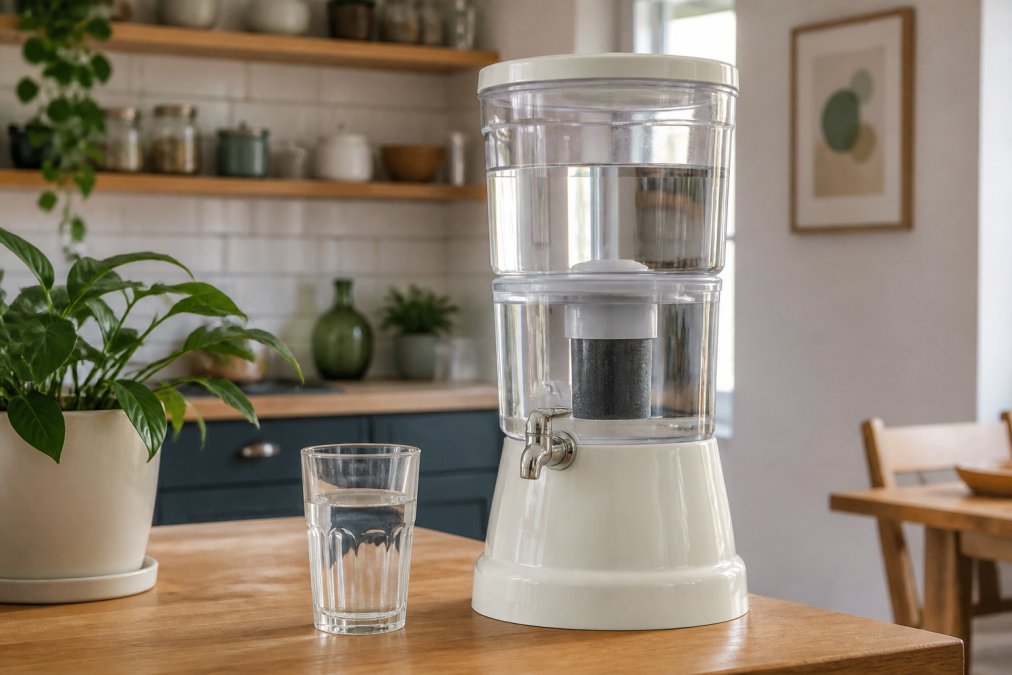
Waters Co's bench top range covers this category well. The BIO 400 holds 5.25 litres and the BIO 400 MAX holds 7 litres, both with a filter set rated for up to 12,000 litres or 18 months. The AceBio+ jug uses the same gravity principle in a 1.0 litre countertop format with a filter.

The trade-off is speed. Gravity systems fill more slowly than a mains-pressure unit, so you fill the reservoir and let it work. For a household of four, a 7 litre reservoir filled once in the morning covers most of the day.
If you need water instantly and continuously, gravity will frustrate you, plan around the reservoir, not against it.
Jugs and Portable Filters for Small Flats and Rooms
Jugs and portable bottles are the cheapest entry point into filtered water, and the right choice when space is the constraint.
A jug lives in the fridge door or on a narrow shelf. The ♥MyWaterJug 1.5L is a jug with a cartridge rated for up to 300 litres or 90 days, suiting one or two people. For a single room or desk, the Mini BMP Waterman 600ml is a fill-and-drink bottle with the same 300-litre rating.

Three things decide between them:
- Capacity: a 1.5 litre jug covers roughly a day of drinking for one person
- Fridge fit: measure your shelf gap before buying, not after
- Refill habit: bottles need filling more often, which is either a feature or a chore
Water Filter Cartridge Replacement Frequency and Running Costs
Cartridge replacement frequency is set by litres filtered, not the calendar, and every Waters Co system states its rating upfront. The AceBio+ filter set runs up to 4,800 litres or 24 months; bench top filter sets up to 12,000 litres or 18 months; ♥MyWaterJug and Waterman cartridges up to 300 litres or 90 days.
The honest way to compare running costs is cost per litre:
| System | Filter Life | Cost Per Litre | Annual Filter Spend |
|---|---|---|---|
| Bench top (BIO range) | Up to 12,000 L / 18 months | Around 3p | Low, spread over 18 months |
| AceBio+ jug | Up to 4,800 L / 24 months | Low | Very low per year |
| ♥MyWaterJug / Waterman | Up to 300 L / 90 days | Higher | Four cartridges per year |
Here is the part most rental guides skip: hard water shortens filter life. In a high-hardness area, expect cartridges to reach their limit sooner than the rated figure, because the filter is capturing scale-forming minerals as well as everything else (pubmed.ncbi.nlm.nih.gov). Budget for it.

Best Water Filter for Hard Water Areas: Scale, Limescale and Rental Appliances
The best water filter for hard water areas is one with an ion exchange stage, which targets the calcium and magnesium ions that form limescale rather than just improving taste and odour.
This is the angle most rental guides miss. In a rented home you do not own the kettle, washing machine, dishwasher or boiler. Limescale shortens the life of all of them, and a scaled or failed appliance is a deposit dispute waiting to happen, hard to argue against when the cause is visible inside the machine.
How the mechanisms differ
Not all filtration stages do the same job on hard water:
- Ion exchange resin swaps calcium and magnesium ions for sodium or hydrogen ions, which is what actually reduces scale formation. This is the stage that matters most in a hard water postcode.
- Activated carbon removes chlorine, taste and odour compounds, and some organic contaminants. It does nothing for hardness.
- Mineral and alkalising stages adjust taste and pH but do not soften water.
- Sediment and ceramic stages trap particulates and protect the stages behind them, extending cartridge life.
A carbon-only jug will improve how water tastes but will not stop your kettle furring. If scale is your problem, you need ion exchange in the stack.
How to tell if your water is hard
UK water hardness is measured in milligrams of calcium carbonate per litre (mg/L CaCO₃), and suppliers publish this by postcode (Water Hardness / Hard Water). As a rough guide:
- Under 60 mg/L, soft
- 60-120 mg/L, moderately hard
- 120-180 mg/L, hard
- Over 180 mg/L, very hard
You can also read the signs in your kitchen: if your kettle furs within weeks, if there is a chalky film inside the kettle or showerhead, or if soap lathers poorly, you are almost certainly in a hard or very hard area. Your supplier's website confirms the exact figure for your postcode.
What hard water does to rental appliances
Scale builds up wherever water is heated or left to evaporate:
- Kettles lose efficiency as the element scales over, and eventually fail.
- Washing machines and dishwashers scale on heating elements and internal pipework, shortening service life and increasing energy use.
- Boilers and combi units can scale internally, which is a landlord-level repair cost and a common source of end-of-tenancy disputes.
- Taps and showerheads clog and lose flow, and the limescale is visible at inspection.
A filter that removes hardness minerals before the water reaches those appliances reduces the rate at which scale forms. It does not eliminate occasional descaling, but it slows the process considerably.
The cost-of-ownership angle
Hard water shortens filter life. In a very hard area, expect cartridges to reach their rated litre limit sooner than the headline figure suggests, because the filter is capturing scale-forming minerals alongside everything else. Budget for that when comparing systems.
The honest comparison is cost per litre over three years, not purchase price:
| System type | Typical filter life | Cartridges over 3 years | Cost per litre |
|---|---|---|---|
| Gravity-fed bench top | Up to 12,000 L / 18 months | 2 | Around 3p |
| Long-life jug | Up to 4,800 L / 24 months | 1-2 | Low |
| Short-life jug | Up to 300 L / 90 days | Around 12 | Higher |
A cheap jug with a 300-litre cartridge looks inexpensive at the till but costs several times more per litre than a bench top system over three years. In hard water areas that gap widens, because short-life cartridges clog faster than the rating implies.
Waters Co systems include ion exchange and mineral stages alongside carbon filtration. If your kettle furs up within weeks, prioritise ion exchange over everything else.
Faucet Compatibility, Filter Disposal and Other Renter Realities
Faucet-mounted filters are the option most likely to disappoint a renter, because they only fit standard screw-thread aerators. Pull-out spray heads, integrated aerators, ceramic disc spouts and non-standard European fittings will not accept one. Before ordering anything that screws onto the tap, spend two minutes identifying what you have.
How to identify your aerator thread
Almost all screw-on faucet filters use one of two metric thread sizes:
- M22 (22 mm), the most common size on kitchen mixer taps in the UK
- M24 (24 mm), found on many European-brand taps and some bathroom basins
A smaller number of taps use M21.5, M18.5 or proprietary fittings that no universal adapter covers.
To measure yours:
- Unscrew the aerator from the end of the spout (it usually turns by hand; a coin or a rubber strap helps if it is tight).
- Measure the outside diameter of the threaded section in millimetres with a ruler or calipers.
- If it reads roughly 22 mm, you need an M22 adapter. If it reads roughly 24 mm, you need M24.
- If the aerator will not unscrew, or the spout is a single sealed unit, a faucet-mounted filter is not an option, choose a bench top or jug system instead.
Renters often buy a faucet filter, discover the thread is non-standard, and face return postage. Measuring first avoids that.
When a faucet-mounted filter is the wrong choice
Even with the right thread, faucet-mounted units have limits worth knowing before you commit:
- Filter life is short, typically two to three months, far less than a gravity-fed set rated for 12,000 litres.
- Flow rate drops as the cartridge loads, which is noticeable on a low-pressure supply.
- They occupy the spout, so filling a large pan or the kettle becomes awkward.
- They leave a visible fitting on a tap you do not own, which some landlords view as a modification even though nothing is drilled.
If any of those matter, a countertop gravity system sidesteps the tap entirely, no thread, no adapter, no compatibility question.
Disposing of spent cartridges
Proprietary cartridges cannot go in kerbside recycling in most areas. They contain spent carbon, ion exchange resin and captured contaminants, so they belong in general waste unless the manufacturer runs a take-back scheme. Check the packaging or the brand's website before assuming otherwise.
This is a genuine environmental argument for long-life filter sets. A gravity-fed set rated for 12,000 litres produces a handful of spent cartridges over its life; a 300-litre jug cartridge produces dozens over the same volume. If sustainability matters, compare filter life per litre, not purchase price.
The renter's pre-purchase checklist
Run through this before you buy anything:
- Does it require any drilling, plumbing or tap modification?
- If it is faucet-mounted, have you measured your aerator thread (M22, M24 or other)?
- Will it fit your worktop, fridge shelf or cupboard?
- What is the filter life in litres, not months?
- What does one cartridge cost, and how many will you need per year?
- Is your water hard? If so, does the filter address scale?
- How do you dispose of spent cartridges, and does the maker take them back?
Frequently Asked Questions
What is the best water filter for a small apartment without plumbing?
A gravity-fed countertop purifier such as the BIO 400 or BIO 500 needs no plumbing at all. You fill the top chamber, water passes through filtration stages and collects in the lower reservoir. The 5.25 litre models suit one or two people, while the 7 litre MAX versions work better for families. For tighter spaces, a 1.0 or 1.5 litre jug fits on a shelf or in the fridge door.
Do countertop water filters require plumbing?
No. Gravity-fed countertop water filters operate without any tap connection, electricity or drilling. You pour tap water into the upper chamber and let it filter down. This makes them ideal for renters who cannot modify pipework or install an under-sink system. The only requirement is a flat surface near a tap for refilling, plus somewhere to store the unit when not in use.
How often do I need to replace the filter cartridge, and what does it cost?
Replacement frequency depends on the model and your water quality. The AceBio+ jug filter lasts up to 4,800 litres or 24 months. The MyWaterJug cartridge lasts up to 300 litres or 90 days. Bench top BIO systems run up to 12,000 litres or 18 months. At roughly 3 pence per litre for bench top models, the running cost is far below bottled water, though hard water areas may shorten filter life.
Can I use a no-plumbing water filter if I have hard water?
Yes, but expect shorter filter life. Hard water carries more calcium and magnesium, which speeds up scale buildup inside the cartridge and reduces flow rate. A gravity-fed system with a submicron pre-filter and ion exchange medium handles hardness better than a basic jug. If limescale is a persistent problem in your rental, choose a model with a larger filter set and check the cartridge every few weeks.
What should I do with used filter cartridges?
Most cartridges contain activated carbon, ion exchange resin and plastic housings, so they cannot go in standard recycling. Check whether the manufacturer offers a take-back or refill programme. Where that is not available, empty and dry the cartridge before disposing of it in general waste, and avoid sending whole cartridges to landfill where possible. Buying a system with longer filter life reduces how often you face this question.
Renting should not mean settling for tap water you do not trust. Waters Co has spent over 40 years building gravity-fed systems that need no installation, no landlord permission and no pipework, from the £64.99 ♥MyWaterJug 1.5L to the £349.00 BIO 500 MAX 7 Litre, all backed by a lifetime warranty and rated 4.9 out of 5 from 2,656 reviews. Get started with Waters Co and turn your rented kitchen into a source of clean, alkalised, mineral-rich water.