

Best Water Filter for Rented Apartments: 5 Top Picks
Table of Contents
- Why Rented Apartments Need a Different Kind of Water Filter
- Quick Comparison: 5 Water Filters for Rented Apartments
- 1. AceBio+ 1.0 Litre Alkaline Mineral Water Filter Jug
- 2. MyWaterJug 1.5L Water Filter
- 3. BIO 400 5.25 Litre Bench Top Water Filter
- 4. BIO 500 5.25 Litre Bench Top Water Filter
- 5. BIO 500 MAX 7 Litre Bench Top Water Filter
- How to Install a Water Filter Without Drilling
- Frequently Asked Questions
Last Updated: October 12, 2026
Why Rented Apartments Need a Different Kind of Water Filter
Renting changes the question: you cannot drill through a worktop or re-route pipework without permission, so the best water filter for rented apartments sits on a surface, attaches to a tap, or needs no plumbing.

At Waters Co, we have spent more than 40 years building gravity-fed filtration systems, and tenants ask one question most: what can I install without losing my deposit?
Point-of-use filtration treats water where you drink it, not at the mains, for renters, that means jugs, dispensers and bench top units.
What Landlords Usually Allow (and What They Don't)
Most tenancy agreements permit freestanding appliances on a worktop, but rarely permanent modifications to plumbing, cabinetry or tiling.
As a general rule:
- Usually fine: jugs, dispensers, bench top gravity filters, faucet attachments that screw on and off
- Usually needs written consent: under-sink systems, drilled tap holes, plumbed-in reverse osmosis
- Almost always refused: anything that alters pipework or requires a permanent electrical connection
Match the Filter to Your Water, Not the Marketing
Most renters buy a filter because they dislike the taste of chlorine or a neighbour mentioned limescale.
Before you spend anything, do two things.
First, check the public water quality report for your postcode. UK water companies publish annual reports and, in most cases, a postcode-level summary of parameters tested in your supply zone. The parameters that matter most for filter choice are usually:
- Hardness and limescale, relevant if you are in a hard-water area and want to protect a kettle or coffee machine
- Chlorine and chloramine, the most common reason tap water tastes or smells off
- Lead, more likely in older housing stock with original pipework (Lead in Drinking Water)
Second, if the report does not answer your question, test the water at the tap. A home test strip gives a rough read on hardness, pH and chlorine; a laboratory analysis is more reliable if you suspect lead.
Certification: What the Claims on the Box Actually Mean
Filtration performance is not a single number: a filter that removes 99% of chlorine may remove very little lead, and one that reduces lead may do nothing for limescale.
A practical rule: if a filter claims to remove "up to 99% of contaminants" without naming the contaminants or the standard, treat it as marketing.
A Simple Decision Path for Renters
- Identify your main concern. Taste and odour, limescale, or a specific contaminant such as lead.
- Check the water report for your postcode and note which parameters are present.
- Match the certification to the concern. Chlorine and taste need carbon filtration; lead and heavy metals need a filter tested against the relevant health-based standard; limescale needs an ion-exchange or similar scale-reduction stage.
- Then choose the format, jug, dispenser or bench top, based on how much water you drink and how much space you have.
That order matters. Choosing the format first and the filtration second is how renters end up with a filter that solves a problem they do not have.
Quick Comparison: 5 Water Filters for Rented Apartments
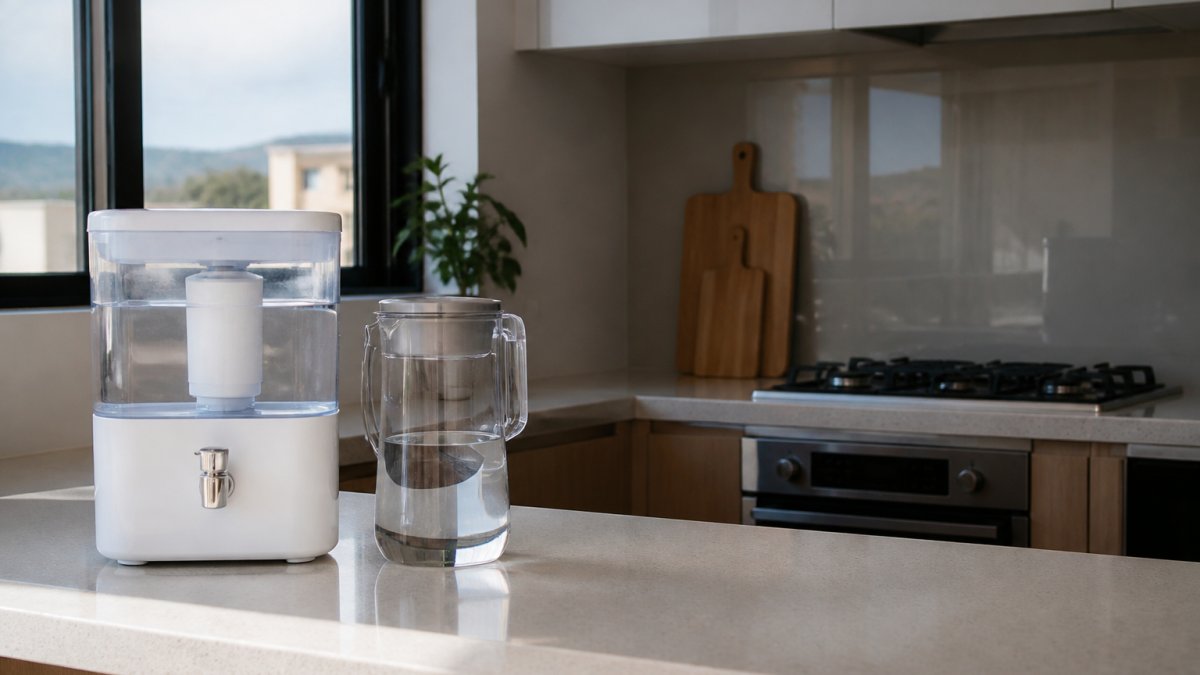
All five are freestanding, need no plumbing, and can be packed into a box on moving day.
| Model | Capacity | Price | Filter Life | Best For |
|---|---|---|---|---|
| AceBio+ 1.0L Jug | 1.0 litre | £125.00 | Up to 4,800 litres / 24 months | Fridge storage, one or two people |
| MyWaterJug 1.5L | 1.5 litre | £64.99 | Up to 300 litres / 3 months | Lowest upfront cost |
| BIO 400 5.25L | 5.25 litres | £329.00 | Up to 12,000 litres / 18 months | Families, light grey finish |
| BIO 500 5.25L | 5.25 litres | £329.00 | Up to 12,000 litres / 18 months | Families, black finish |
| BIO 500 MAX 7L | 7 litres | £349.00 | Up to 12,000 litres / 18 months | Larger households, more capacity |
1. AceBio+ 1.0 Litre Alkaline Mineral Water Filter Jug
Our top pick for most renters. The AceBio+ packs 10 stages of filtration into a jug small enough for a fridge door shelf, the hardest thing to find in a rental-friendly water filter.


It reduces sediment, rust, bacteria, cysts, chlorine, chemicals, heavy metals, fluoride and odours. A patented nano activated carbonate compound handles fluoride; coconut shell carbon bonded with silver tackles chlorine and heavy metals.
The included filter set lasts up to 4,800 litres or 24 months, unusually long for a jug.
Pros and Cons
Pros: Compact enough for a fridge, no electricity or tap connection, 10 filtration stages, very long filter life, BPA/BPB/BPS-free construction.
Cons: One litre is a small pour, so a family will refill it often. The higher upfront price sits well above a basic supermarket jug.
Pricing and Running Costs
The AceBio+ costs £125.00 as a one-time purchase, with the first filter set included. Because that set runs up to 24 months, the annual running cost is spread across two years.
2. MyWaterJug 1.5L Water Filter
Filtration removes up to 99% of chlorine, fluoride, heavy metals, chemicals and bacteria, and each cartridge replaces up to 330 single-use 600ml bottles.
The trade-off is filter life. Where the AceBio+ runs 24 months, the MyWaterJug cartridge lasts up to 300 litres or about 3 months.
Pros and Cons
Pros: Cheapest way into the range at £64.99, 1.5 litre capacity, portable for work or travel, bacteriostatic filter design, BPA/BPB/BPS-free.
Cons: Shorter cartridge life means more frequent replacements. At 1.5 litres it still needs regular refilling for a family.
Pricing and Running Costs
£64.99 upfront, with refill packs of three cartridges sold separately. You will replace the cartridge roughly four times a year, so budget for refills rather than treating the jug price as the full cost.
3. BIO 400 5.25 Litre Bench Top Water Filter
A countertop gravity filter for households that drink a lot of water.
It filters out up to 99% of sediment, rust, bacteria, cysts, chlorine, chemicals, heavy metals, fluoride and odours.
No electricity, no tap connection, no drilling. It sits on the worktop and you fill it by hand.
Pros and Cons
Pros: 5.25 litre capacity, 13 stages, up to 18 months per filter set, lifetime warranty, adds over 60 bio-organic trace minerals.
AceBio+ 1.0 Litre Alkaline Mineral Water Filter Jug →
Cons: It occupies permanent worktop space, which matters in a small kitchen. At 4.2kg empty, you will not want to move it often.
Pricing and Running Costs
£329.00 with the filter set included. Spread across 18 months, the per-litre cost is a fraction of bottled water, with no electricity draw.
4. BIO 500 5.25 Litre Bench Top Water Filter
This is the same system as the BIO 400 in a black finish: identical 13 stages, 5.25 litre capacity, up to 12,000 litre filter life and £329.00 price.
So why list it separately? Because finish matters in a rental: with dark worktops or black appliances, the light grey BIO 400 will look out of place every day.
Pros and Cons
Pros: Everything the BIO 400 offers in a black finish, 99% fluoride reduction claim, lifetime warranty, no installation required.
Cons: Same worktop footprint as the BIO 400. If you want more capacity, you need the MAX instead.
Pricing and Running Costs
£329.00, filter set included, up to 18 months of use before replacement. Running costs match the BIO 400 because the internals are the same.
5. BIO 500 MAX 7 Litre Bench Top Water Filter
The largest capacity in the range, and the right answer for a shared house or a family that gets through several litres a day. The MAX takes the BIO 500 platform and fits a 7 litre reservoir.
It produces water in the pH range of 7.6 to 8.5, adds over 60 bio-organic trace minerals, and filters up to 99% of the same contaminant list as the rest of the bench top line.
For renters, the appeal is fewer refills: a 7 litre reservoir covers a full day of drinking and cooking for most households.
Pros and Cons
Pros: 7 litre capacity, 13 stages, pH 7.6 to 8.5, up to 18 months per filter set, lifetime warranty, no plumbing.
Cons: The largest footprint of the five, so it needs genuine counter space. At £349.00 it is the priciest option here.
Pricing and Running Costs
£349.00 with the filter set included. Around 3 pence per litre, with no electricity and no connection fees.
How to Install a Water Filter Without Drilling
Installation is the part renters worry about most, and it is the easiest part. None of the five systems above requires a drill, a plumber or a landlord's signature.
- Unbox and rinse. Wash the reservoir and jug with warm soapy water, then rinse thoroughly.
- Fit the filter cartridge. Seat it firmly in the housing. A loose cartridge lets water bypass the filter medium.
- Discard the first batch. Run one full reservoir through and pour it away. This clears loose carbon fines.
- Fill and wait. Gravity does the work. A full bench top reservoir takes a few minutes to pass through.
- Store and repeat. Keep the jug in the fridge or the bench top unit on the counter, and refill as needed.
When you move out, reverse the process. Empty the reservoir, remove the cartridge, and pack the unit.
The Real Cost of Ownership
The purchase price is the least useful number when comparing filters.
To work it out, you need three figures: the upfront price, the replacement cartridge price, and the rated filter life in litres.
Using the five systems in this guide as an example:
- AceBio+ 1.0L Jug, £125.00 upfront, first filter set included and rated up to 4,800 litres. Because the included set covers up to 24 months, the annual running cost is spread across two years, making it unusually cheap per litre for a jug.
- MyWaterJug 1.5L, £64.99 upfront, but the cartridge is rated up to 300 litres, so you will replace it roughly four times a year. The refill packs are the real cost, not the jug.
- BIO 400 and BIO 500, £329.00 upfront with a filter set rated up to 12,000 litres, roughly 3 pence per litre before any replacement set.
Two costs renters often forget. First, cartridge availability, check replacements are stocked before you buy, because a discontinued cartridge turns a working filter into a paperweight.
Lease, Landlord and Move-Out Checklist
Before you buy, run through this list. It takes ten minutes and prevents most deposit disputes.
- Read the alterations clause. Look for wording on fixtures, fittings and permanent changes. Freestanding appliances are usually covered by general permission to use the property reasonably, but confirm it.
- Ask in writing if unsure. A short email to the landlord or letting agent asking whether a countertop filter is acceptable is enough. Keep the reply.
- Check the tap. For a faucet-mounted attachment, confirm the spout is a standard threaded aerator. Pull-down and pull-out spray taps often are not compatible without an adapter, and some cannot take one at all.
Apartment-Specific Compatibility and Troubleshooting
Small kitchens and modern tap designs create problems that do not show up in product photos.
- Faucet aerators. Most screw-on adapters fit a standard aerator, but thread size varies. If the adapter will not seat, the aerator is the wrong size rather than the filter being faulty.
- Pull-down and pull-out taps. These often have a non-standard spout and cannot take a screw-on adapter; a jug or bench top unit sidesteps the problem entirely.
- Low water pressure. Gravity systems do not need mains pressure, an advantage in older buildings or upper-floor flats where pressure drops, but they need time, and a full reservoir can take several minutes to pass through.
The best water filter for a rental is the one you can take with you. Every system here is freestanding, drill-free and portable, so your filtration investment moves house when you do.
Frequently Asked Questions
Can you put a water filtration system in a rented apartment?
Yes, as long as you choose a system that doesn't require permanent plumbing changes or drilling. Gravity-fed jugs and bench top filters sit on the counter and need no tap connection or electricity. Before buying, check your tenancy agreement for clauses about alterations. Most renter-friendly filters leave no trace when you move out, so they fit within standard rental restrictions without needing landlord approval.
What is the best water filter for renters who cannot drill?
The best water filter for renters who cannot drill is a gravity-fed jug or bench top system. The AceBio+ and MyWaterJug sit on a counter or in a fridge and need no installation at all. Bench top models like the BIO 400, BIO 500 and BIO 500 MAX work the same way, with larger capacities. None require drilling, plumbing or permanent fixtures, and all can be packed up and moved when your tenancy ends.
Do countertop water filters need plumbing changes?
No. The countertop water filters in this guide are gravity-fed, meaning you fill the top reservoir by hand and water passes through the filter into the lower tank. There is no connection to your mains supply, no plumbing changes and no electricity needed. This makes them ideal for rented apartments, as you can set one up in minutes and remove it just as quickly when you move.
How often should you replace a water filter cartridge?
It depends on the model. The MyWaterJug cartridge lasts up to 300 litres or around 3 months. The AceBio+ filter set lasts up to 4,800 litres or up to 24 months. The BIO 400, BIO 500 and BIO 500 MAX filter sets last up to 12,000 litres or up to 18 months. Actual filter lifespan varies with your daily usage and the quality of your tap water, so check your filter reminder service where available.
Are water filter jugs or tap-mounted filters better for a rented flat?
Jugs and bench top filters are usually better for a rented flat because they need no installation, no drilling and no plumbing changes. Tap-mounted filters attach to your existing faucet but may not fit every tap type and can be knocked loose in small kitchens. A jug or bench top system avoids faucet compatibility issues entirely and moves with you when your tenancy ends.