

7 Steps to Start a Plastic Free Kitchen in 2026
Last Updated: October 25, 2026
Quick Summary
To start a plastic free kitchen, swap your most-used items first: replace cling film with beeswax wraps, plastic bags with silicone bags, and scratched boards with wood. Stop buying bottled water by filtering tap water, and replace worn plastic as it wears out rather than all at once.
- Keep replacements where the plastic used to live so you reach for them out of habit.
- Glass suits leftovers and reheating, stainless steel suits lunchboxes and travel, silicone bags suit freezing.
- Do not heat food in plastic; transfer it to glass or stainless steel before microwaving.
- Retire scratched plastic boards and worn non-stick pans first, since abrasion sheds particles into food.
- A filter set rated for up to 12,000 litres spreads its price across years of drinking water.
Table of Contents
- 7 Steps to Start a Plastic Free Kitchen
- Plastic-Free Kitchen Swaps That Actually Work
- Plastic-Free Food Storage: Glass, Stainless Steel and Silicone
- How to Avoid Microplastics in Food Every Day
- A Plastic-Free Kitchen on a Budget: What to Buy First
- Care, Cleaning and Lifespan of Your New Kitchen Materials
- What to Do With the Plastic Already in Your Kitchen
- Choosing a Water Filter to Cut Bottled Plastic
- Frequently Asked Questions
7 Steps to Start a Plastic Free Kitchen
Starting a plastic free kitchen begins with one honest look at your food storage and the water you drink.
Most kitchens are full of plastic before anyone notices, in storage containers, utensils, sponges and the bottles in the fridge.
Below, we show you how to start a plastic free kitchen without wasting money on the wrong things. Each step takes minutes, and you can spread them across a few weeks.
Plastic-Free Kitchen Swaps That Actually Work
The swaps that last are the ones you barely notice. A common mistake is buying a whole new set of containers before clearing out the old ones. Start with the items you use daily and replace them as they wear out.
Here is what tends to work in practice:
- Cling film becomes beeswax wraps or lidded glass bowls
- Plastic food bags become silicone storage bags or stainless steel boxes
- Plastic chopping boards become wooden boards
Replacing Plastic Wrap and Food Bags
Cling film and food bags are the easiest first win. Most people use them without thinking, then throw them away within a day.
Swap cling film for beeswax wraps on bowls and sandwiches. Use lidded glass containers for leftovers instead of covering plates.
The trick is to keep the replacements where the plastic used to live. If the wraps sit in a drawer, you will reach for the roll out of habit.
Wooden Cutting Boards and Utensils
Wooden cutting boards and utensils are a simple, long-lasting alternative to plastic. Plastic boards shed tiny particles into food as they scratch, and those scratches also trap bacteria.
Wood is naturally antibacterial when kept clean and dry. Choose a board with a deep groove for juices, never leave it soaking, and it can last for years, cheaper over time than a stream of plastic ones.
Plastic-Free Food Storage: Glass, Stainless Steel and Silicone
Glass containers, stainless steel lunchboxes and silicone storage bags form the core of plastic-free food storage. Each suits a different job, so most kitchens end up using all three.
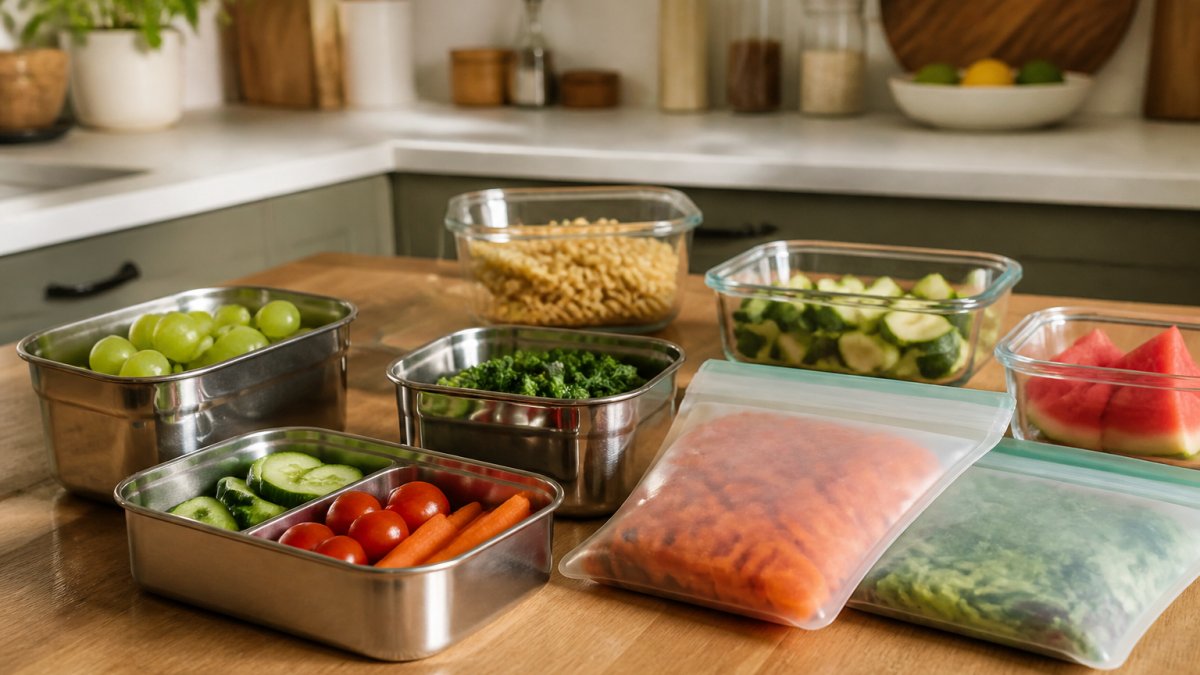
Glass is best for leftovers and reheating, since it does not stain or hold odours. Stainless steel is the toughest option and works well for lunches and travel.
| Material | Best For | Watch Out For |
|---|---|---|
| Glass | Leftovers, reheating | Heavy and breakable |
| Stainless steel | Lunchboxes, travel | Not microwave-safe |
| Silicone bags | Freezing, packed lunches | Can hold odours |
How to Avoid Microplastics in Food Every Day
Microplastics are small plastic particles that shed from packaging, bottles, cookware and textiles, reaching food and drink through contact, heat and abrasion. The practical question is not how to eliminate every particle, but which everyday habits reduce the largest and most avoidable sources.
How particles actually get into food
Three mechanisms account for most kitchen exposure:
- Heat and fat. Heat softens plastic and speeds up the release of particles and chemical additives. Fatty foods absorb more from plastic contact than watery ones. This is why reheating leftovers in a plastic tub is a bigger issue than storing dry pasta in one.
- Abrasion. Scratched plastic boards, worn non-stick coatings and stiff brushes on plastic surfaces shed material directly into food. Visible scratches are the signal to retire an item.
- Contact time and packaging. Long storage in plastic, especially in direct sun or warm conditions, increases migration. Bottled water is a well-documented example because the water sits in plastic for months and is often stored warm.
The habits that make the biggest difference
- Do not heat food in plastic. Transfer to glass or stainless steel before microwaving. If you must use a plastic container, check whether it is marked microwave-safe and avoid reheating fatty or acidic foods in it.
- Retire scratched plastic boards and worn non-stick pans. Abrasion is a direct route into food, and a scratched surface is also harder to clean properly.
- Choose glass or stainless steel for storage where you can. Both are inert, do not absorb odours and do not shed particles into food.
- Cut bottled water. Filter tap water and carry it in stainless steel or glass. This removes a repeated source rather than a one-off one.
- Avoid plastic utensils in hot pans. Silicone and stainless steel are better for high-heat cooking; wooden tools are fine for most tasks if kept clean and dry.
Where the evidence is still uncertain
The science on microplastics and health is developing. Researchers have found particles in food, water and human tissue, but the size of the health effect at typical exposure levels is not settled. Be sceptical of any source giving a precise percentage reduction or definitive harm figure without citing a specific study. Reduce obvious, high-exposure routes, heating food in plastic, drinking from plastic bottles, without alarming yourself about every plastic item in the home.
Material safety at a glance
- Glass: inert, no migration, safe for heat and fat. Heavy and breakable.
- Stainless steel: inert, durable, good for heat and acidic foods. Not microwave-safe.
- Silicone: generally stable and heat-resistant, but lower-grade silicone can retain odours and may contain fillers. Buy food-grade silicone and replace it if it smells or tears.
Water is the repeated exposure
Food gets most of the attention, but drinking water is a daily, repeated route. Our BIO 400 5.25 Litre Bench Top Water Filter uses multi-stage filtration to remove microplastics and other contaminants, and our guide on how to remove microplastics from drinking water explains what different filter types do and do not remove.

For the everyday sources most people miss, our guide on how to reduce microplastics intake goes further.
A Plastic-Free Kitchen on a Budget: What to Buy First
Most guides tell you what to buy; fewer tell you what pays you back. The sequence below is ordered by cost per use, so items replacing the most repeated spending come first and convenience items come last.
AceBio+ 1.0 Litre Alkaline Mineral Water Filter Jug →
A useful rule of thumb: a swap is worth making when the replacement costs less per use than the disposable it replaces, or when it removes a purchase you would otherwise repeat every week.
The payback order
- Stop buying bottled water first. This is usually the largest recurring plastic cost in a kitchen. A bench top filter with a filter set rated for up to 12,000 litres spreads its purchase price across years of drinking water, which is why it belongs at the top of the list even though the upfront figure is the biggest. Work out your own figure by dividing the unit price by the rated litre capacity, then compare that cost per litre with what you currently pay for bottled water.
- Replace the scratched plastic chopping board. A wooden board costs more than a thin plastic one at the till but is not replaced every year or two. Divide the price by the years you expect to keep it and the gap narrows sharply.
- Add glass containers you will actually use. Buy two or three lidded glass containers in the sizes you reach for most, rather than a full set. A small number used daily beats a cupboard full used rarely.
- Switch lunch packaging. Beeswax wraps and silicone bags replace a roll or box bought repeatedly. Buy one pack, use it for a month, then decide whether you need more.
- Upgrade washing-up tools last. Plant-based scourers and bamboo brushes are cheap but wear out, so they are a low-risk final step rather than a priority spend.
Where the money actually goes
Households spend the most on the items they replace most often: bottled water, cling film, food bags and sponges. Attack those four lines first. Containers, boards and utensils are one-off purchases that sit still for years, so they are lower priority even though they are the most visible swaps.
Affordable routes that are not new products
You do not have to buy your way into a lower-plastic kitchen. The cheapest moves involve using what you already own:
- Jars and takeaway containers you already have can store dry goods and leftovers. Glass jars with screw lids are free storage.
- Plates as lids work for bowls in the fridge and cost nothing.
- A tea towel over a bowl replaces cling film for proving dough and resting food.
What to skip for now
Some swaps are expensive and rarely earn their place early on: full matching container sets, specialist silicone cookware ranges and single-purpose gadgets. They add cost without removing much repeated plastic, so buy them only if a specific job genuinely needs them.
A realistic first-month budget
A sensible starting point is one recurring-cost swap and one durable item, then pause. For example, a filter to end bottled water plus a wooden board to replace a scratched one covers the two highest-impact changes without a large outlay.
If you want the numbers on the water side specifically, our countertop filter vs bottled water comparison sets out the cost per litre over a year, and our guide on how to stop buying bottled water covers the practical steps.
Care, Cleaning and Lifespan of Your New Kitchen Materials
Replacement materials only save money if they last. The care routine is simple, but skipping it is where most people go wrong.
- Wooden boards: wash by hand, dry upright, oil every few months
- Glass containers: dishwasher-safe, but check lids for cracks
- Stainless steel: hand wash to keep it shiny, dry fully to avoid marks
A wooden board that is never left wet can outlast several plastic ones. That is the real budget win: fewer replacements over the years.
What to Do With the Plastic Already in Your Kitchen
Do not throw out usable plastic in a rush. It takes years to break down in landfill, so use what you have until it wears out, then replace it with a better material.
Here is a simple plan:
- Keep safe plastic containers for dry goods and non-food storage
- Retire scratched or cracked items first, since these shed the most particles
- Recycle what your local council accepts, and check the symbols first
This phased approach keeps costs down and stops waste. You replace only what genuinely needs replacing.
Choosing a Water Filter to Cut Bottled Plastic
A water filter is the single biggest plastic swap in most kitchens, removing the need for bottled water, where a lot of household plastic waste begins.
Look for three things: what the filter removes, how long the filters last, and the cost per litre. A gravity-fed system needs no plumbing, which suits renters and anyone who cannot fit an under-sink unit.
Waters Co has built filtration systems since 1984, covering jugs and bench top units.
If you want the detail on filtration, read our guide on how to remove microplastics from drinking water.
Frequently Asked Questions
What should I replace first when starting a plastic free kitchen?
Start with the items you use every day and that touch food directly. Swap plastic food bags and cling film for glass containers or silicone storage bags, then replace your plastic chopping board with a wooden one. These three changes cut the most single-use plastic and reduce how to avoid microplastics in food. Leave larger items like plastic storage tubs until they wear out, so you spread the cost and avoid waste.
Can I make my kitchen plastic-free on a budget?
Yes. A plastic-free kitchen on a budget works best in stages. Use charity shops and second-hand sites for glass jars and stainless steel tins, buy wooden utensils and a wooden chopping board as one-off purchases, and choose a filter jug instead of bottled water. The AceBio+ 1 Litre Alkaline Mineral Water Filter Jug at £125.00 replaces up to 4,800 litres of bottled water, which quickly pays for itself compared with shop-bought bottles.
Are glass or stainless-steel containers better than plastic?
Glass and stainless steel are both better choices for food storage because they do not leach chemicals and can be reused for years. Glass is best for leftovers and reheating because you can see the contents and it does not hold odours. Stainless steel is lighter and better for lunchboxes and travel. Silicone storage bags are a flexible middle option. Whichever you choose, avoid hot food in plastic and never microwave in plastic containers.
How do I avoid microplastics in food at home?
The main routes are packaging, chopping boards and water bottles. Store food in glass or stainless steel, use a wooden chopping board instead of plastic, and stop buying bottled water. A water filter jug such as the MyWaterJug 1.5L at £64.99 filters tap water and cuts the microplastics found in most bottled brands. Also avoid plastic utensils in hot pans and replace worn plastic containers with cracks or scratches.
Starting a plastic free kitchen is less about perfection and more about steady swaps that fit your routine. The hardest part is often the water you drink, and that is where we can help. Waters Co systems remove up to 99.9% of contaminants, including microplastics and heavy metals, while remineralising your water with essential minerals. Our filters last up to two years, and every product carries a lifetime warranty. Get started with Waters Co and cut bottled plastic from your kitchen for good.
