

How to Remove Microplastics From Drinking Water
Table of Contents
- What Microplastics in Drinking Water Actually Are
- Health Risks of Microplastic Ingestion and Human Exposure
- Boiling Water for Microplastic Decontamination: What It Can and Cannot Do
- The Micron Rating for Microplastic Removal You Need to Look For
- Best Water Filter for Microplastics UK Households Can Buy
- How to Verify Water Filter Lab Testing Before You Buy
- How to Remove Microplastics From Drinking Water: Step-by-Step
- Frequently Asked Questions
Last Updated: October 2, 2026
What Microplastics in Drinking Water Actually Are
Microplastics are plastic fragments smaller than 5 millimetres, nanoplastics those below 1 micrometre; both are routinely detected in tap water. This guide from Waters Co explains how to remove microplastics from drinking water with filtration you can buy and maintain.
Health Risks of Microplastic Ingestion and Human Exposure
Human exposure is continuous. You ingest particles every time you drink, cook or brew a hot drink, and the smallest fractions matter most.
Boiling Water for Microplastic Decontamination: What It Can and Cannot Do
Boiling is a partial measure, not a solution. It kills bacteria and drives off some volatile chlorine compounds, but it does not remove microplastics, and it will not touch dissolved heavy metals or fluoride. If your goal is to remove microplastics from drinking water, a kettle is the wrong tool, but the mechanism is worth understanding.
The co-precipitation mechanism, explained
In hard water, boiling drives calcium carbonate out of solution. Those crystals form on suspended particles and drag a share into the scale at the bottom of the kettle, the only reason boiling shows any particle reduction at all.
Three limits follow from that mechanism:
- It depends on hardness. Soft water has little calcium carbonate to precipitate, so the effect is negligible.
- It only catches suspended particles. Nanoplastics already in solution are not trapped by settling crystals.
- It leaves the particles in the kettle. The scale you descale away contains whatever was co-precipitated. You have not destroyed the plastic; you have relocated it.
What boiling actually does well
Boiling remains the most effective point-of-use step against microbial contamination and is standard advice during a boil-water notice. It also reduces some volatile organics and residual chlorine, real benefits, but not particle removal.
The cost-per-litre reality
Boiling a litre in an electric kettle draws roughly 0.1 to 0.15 kWh depending on starting temperature and kettle efficiency, a few pence per litre at typical domestic rates, comparable to or higher than a gravity bench top filter over its cartridge life. You are paying filtration-adjacent running costs for a method that does not filter particles.

A rough comparison of running cost per litre:
| Method | Approx. running cost per litre | Removes microplastics? |
|---|---|---|
| Boiling (electric kettle) | A few pence, driven by electricity | No (partial, hardness-dependent) |
| Gravity bench top filter | Around 3 pence, driven by cartridge replacement | Yes, with submicron media |
| Reverse osmosis under-sink | Higher, driven by membrane, water waste and pump energy | Yes |
| Bottled water | Highest by a wide margin | Inconsistently, packaging sheds particles |
The practical takeaway
Boiling is a hygiene step, not a decontamination step. Keep it for supply incidents, and pair it with a filter rated at 1 micron or finer if particle removal is the goal. If you already boil water for tea or coffee, you are not wasting the effort, you are just not removing microplastics by doing it.
The Micron Rating for Microplastic Removal You Need to Look For
The micron rating for microplastic removal is the specification that decides whether a filter works. Anything rated at 1 micron or coarser lets the majority of microplastic particles pass through.
| Method | Typical Pore Size | Removes Microplastics? | Notes |
|---|---|---|---|
| Sediment filtration | 5-20 microns | Partially | Catches debris and larger particles only |
| Granular activated carbon | No fixed pore size | No | Adsorption targets dissolved chemicals, not particles |
| Microfiltration | 0.1-1 micron | Largely yes | Good balance of flow rate and removal |
| Ultrafiltration | 0.01-0.1 micron | Yes | Lower flow rate, needs pressure |
| Reverse osmosis | Below 0.001 micron | Yes | Semi-permeable membrane; also strips minerals |
Best Water Filter for Microplastics UK Households Can Buy
The best water filter for microplastics UK households can buy combines submicron filtration with a particle barrier and a realistic filter lifespan. Pore size wins on paper, but maintenance and running cost decide whether you keep using it.
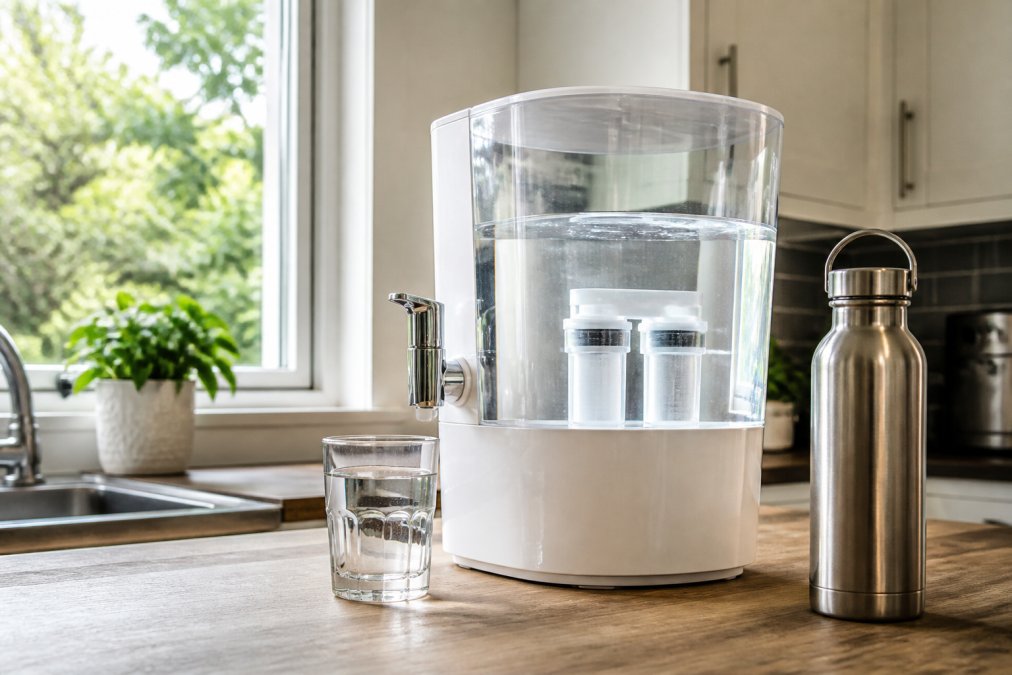
- ♥MyWaterJug 1.5L (£64.99): a 7-stage cartridge filtering up to 99% of chlorine, fluoride, heavy metals, chemicals and bacteria. Each cartridge lasts up to 300 litres or 3 months and replaces up to 330 single-use 600ml bottles.
- AceBio+ 1.0 Litre Jug (£125.00): 10 stages of filtration, with a pre-filter membrane for sediment, rust, bacteria and cysts, plus activated coconut shell carbon bonded with silver. The included filter set lasts up to 4,800 litres or 24 months.
- BIO 400 / BIO 500 Bench Top (£329.00): 13 stages, 5.25 litres, filtering up to 99% of sediment, rust, bacteria, cysts, chlorine, chemicals, heavy metals, fluoride and odours. Around 3 pence per litre, with a filter set lasting up to 12,000 litres or 18 months.
- BIO 500 MAX 7 Litre (£349.00): the same 13-stage filtration with a larger reservoir, pH range 7.6 to 8.5, and over 60 bio-organic trace minerals.
How to Verify Water Filter Lab Testing Before You Buy
Verification comes down to one question: who tested it, and can you see the report? A "99.9% removal" claim without a named laboratory and a downloadable certificate is marketing, not evidence. But the specification that matters most over the filter's life is one almost no guide discusses: what happens to the particles once captured.

The paperwork checklist
Use this before you commit:
- Is there a downloadable test report, not just a percentage on the packaging?
- Does the report name the testing laboratory and the date?
- Does it state which contaminants were tested, and at what influent concentration?
- Does it specify the micron rating of the filtration media?
- Are the claimed certifications (ISO, CE) listed with certificate numbers?
- Does the manufacturer publish filter lifespan in litres, not just months?
- Does the report cover the end of the cartridge's rated life, not just a fresh cartridge?
That last point is the one buyers miss. A filter removing 99% of particles when new may remove far less at 90% of rated capacity, because the media is loaded and flow paths have changed. Ask for the end-of-life figure.
AceBio+ 1.0 Litre Alkaline Mineral →
The maintenance angle competitors skip
Most guides focus on selection. Very few explain the maintenance cycle that prevents microplastic buildup inside the filter itself, the mechanism behind secondary contamination.
The practical maintenance cycle looks like this:
- Track litres, not just months. A cartridge rated for 12,000 litres used by a family of four will reach end of life far sooner than the calendar suggests. Log the installation date and the volume drawn.
- Watch for flow-rate drop. A noticeable slowdown is the first sign the media is loaded. Do not push a cartridge past this point to save money.
- Sanitise housings at every cartridge change. The housing, not just the cartridge, harbours biofilm. A rinse with hot water and a food-safe sanitiser between changes prevents the new cartridge from being contaminated on day one.
- Discard the first fill after every change. New cartridges shed fine carbon dust and, in some designs, manufacturing residue. Run and discard the first reservoir.
- Store filtered water cold and covered. A jug of filtered water left warm and open is a growth medium, not a clean supply.
What happens to the captured microplastics
When you replace a cartridge, the captured microplastics go with it, into general waste, then landfill or incineration. They are not destroyed. A filter is a concentration device, not a destruction device.
UK context on what you are entitled to ask
For context on why verification matters, the Drinking Water Inspectorate guidance on water quality and consumer advice sets out how public supplies are monitored and what consumers are entitled to ask about their water. Separately, the World Health Organization report on microplastics in drinking water remains the clearest plain-language summary of what is known about particle exposure. Waters Co publishes downloadable test results for its filter cartridges, which is the standard to hold any brand to.
How to Remove Microplastics From Drinking Water: Step-by-Step
Removing microplastics from your drinking water takes about 20 minutes of setup, then a maintenance routine. Here is the sequence that works.
Total time: 20-30 minutes Difficulty: Beginner
What you'll need:
- A filter with a stated micron rating of 1 micron or finer
- Your water supplier's latest quality report
- A calendar reminder for cartridge changes
Frequently Asked Questions
Does UK tap water contain microplastics?
Yes. Microplastics and nanoplastics have been detected in treated drinking water supplies around the world, including in the UK. Most particles come from the breakdown of larger plastic items, tyre wear, synthetic clothing fibres and industrial processes, and they survive conventional municipal treatment because the particles are smaller than the filters used. A point-of-use filter with a fine enough micron rating is the practical way to reduce what reaches your glass.
Will a standard jug filter like Brita remove microplastics?
A standard jug filter will capture some larger particulate matter through its sediment and carbon media, but most jug cartridges are not rated to a fine enough micron level to reliably remove the smallest microplastics and nanoplastics. If microplastic removal is your priority, check the stated micron rating and ask for third-party lab testing before buying. A jug with a submicron-rated cartridge gives you a clearer, verifiable performance claim.
What micron rating do I need to filter microplastics?
Microplastics are generally defined as particles under 5 millimetres, and many fall below 10 microns. To capture them reliably, look for a filter rated at 1 micron or finer, and ideally submicron. Microfiltration typically handles particles down to around 0.1 micron, ultrafiltration goes finer still, and reverse osmosis uses a semi-permeable membrane that removes particles at the smallest scale. Anything coarser than 5 microns will let most microplastics through.
How can I verify a water filter actually removes microplastics?
Ask for third-party laboratory test reports, not just marketing percentages. A credible report names the testing lab, the date, the specific contaminants tested and the reduction figures. Check whether the test covers microplastics or only chlorine and heavy metals, because many brands quote a headline figure for one contaminant and imply it applies to all. Waters Co publishes downloadable test results for its filter range so you can check the data before you buy.
Is boiling water effective at removing microplastics?
Boiling kills bacteria but does not remove microplastics. In fact, heating water in plastic kettles or storing it in plastic containers can increase chemical leaching and shed more particles into the water. Boiling is useful for microbiological safety, not for particulate removal. For microplastics you need physical filtration with a fine enough pore size, not heat.
How much does it cost to filter microplastics from tap water?
A portable gravity jug such as the AceBio+ 1.0 Litre costs £125.00 and its filter set lasts up to 4,800 litres or 24 months. A bench top system like the BIO 400 costs £329.00 with filters lasting up to 12,000 litres or 18 months, working out at around 3 pence per litre. Compare that with bottled water and the long-term saving is significant, while also cutting single-use plastic waste.
Do I need a plumber to install a microplastic filter?
Not for gravity-fed jugs and bench top systems. Products like the MyWaterJug 1.5L, AceBio+ and BIO 400 need no electricity and no tap connection, so renters and homeowners can set them up in minutes. You fill the top reservoir and the water passes through the filtration media by gravity into the lower chamber. Only under-sink reverse osmosis systems require plumbing work, which is why portable and bench top options suit most households.