

How to Stop Buying Bottled Water: A 2026 Guide
Table of Contents
- Step 1: Work Out Why You Still Buy Bottled Water
- Step 2: Understand the Cost of Bottled Water vs Tap Water
- Step 3: Address the Taste and Safety Doubts
- Step 4: Learn How to Remove Microplastics from Tap Water
- Step 5: Weigh the Benefits of Water Filtration Systems
- Step 6: Pick the Right System and Build the Habit
- Common Mistakes When You Stop Buying Bottled Water
- Frequently Asked Questions
Last Updated: September 23, 2026
Step 1: Work Out Why You Still Buy Bottled Water
Most people who want to stop buying bottled water are not lazy, they are solving a problem. Until you name it, the habit returns.
| Trigger | What it really means | Fix to try |
|---|---|---|
| You forgot your bottle | No backup in place | Keep a spare in your bag and car |
| Tap water tastes odd | Chlorine taste and odour | Activated carbon filter jug |
| You worry about safety | Fear of contaminants | Water quality testing, then filtration |
| Bottles feel convenient | Habit and ease | Refillable bottle plus filling stations |
Step 2: Understand the Cost of Bottled Water vs Tap Water
The cost of bottled water vs tap water is not close. Even budget supermarket multipacks cost far more per litre than filtered tap water, and the gap widens over a year.
The Real Annual Spend on Bottled Water
Picture a household of four drinking two litres each per day: 2,920 litres a year.
Where Filtered Tap Water Sits on Cost
Filtered tap water sits between free tap water and bottled water on price, but much closer to free.
- Tap water alone: a few pence per litre from your supplier
- Filter jug or bench top system: roughly 3p per litre
- Supermarket bottled water: around 40p per litre
- Branded single bottles: often £1 or more per litre
Step 3: Address the Taste and Safety Doubts
Two doubts keep people on bottled water: taste and safety. Both are technical problems with technical solutions, not feelings to be soothed.
Why Tap Water Tastes the Way It Does
The culprit is usually chlorine, added to keep the municipal supply microbiologically safe as it travels the network, leaving a flat, chemical note. Some suppliers use chloramine instead, which is harder to remove: standard carbon filters struggle with it, so you need catalytic carbon or longer contact time.
What 'Safe' Actually Means in Practice
UK tap water is tightly regulated: the Drinking Water Inspectorate (DWI) enforces standards and suppliers must publish results. For the vast majority of households, water arriving at the property boundary is safe to drink.
The genuine worries sit after that boundary:
- Lead pipework. Older properties, particularly those built before the 1970s, may still have lead service pipes or lead internal plumbing. Lead is a cumulative neurotoxin with no safe level, and it leaches more when water sits in the pipe. Running the tap for a minute helps, but filtration is the more reliable fix.
- Microplastics. These shed from bottles, packaging, clothing and tyre wear, and appear in bottled water as well as tap water. The science is still developing, but the precautionary case for filtering is reasonable.
- Forever chemicals (PFAS). These industrial compounds persist in the environment and have been detected in some UK water sources. Standard carbon filters have limited effect; reverse osmosis or specialised media are needed.
- Hard water. Not a safety issue, but it scales kettles, shortens appliance life and affects taste.
How to Settle the Question for Your Own Home
Water quality varies by postcode, so work through this:
- Check your supplier's water quality report. Every UK water company publishes one free, covering source, hardness and detected contaminants for your area.
- Order a water quality testing kit. Look for lead, chlorine, chloramine, hardness and ideally PFAS. A basic kit costs around £20-£40; a lab test runs higher.
- Inspect your pipework. In an older property, ask a plumber to identify the incoming service pipe and internal runs. Lead is dull grey and soft; you can often scratch it with a coin.
- Match the filter to the finding. Do not buy a filter and hope. If lead is present, you need ion exchange or reverse osmosis. If chloramine is the issue, you need catalytic carbon. If PFAS is the concern, reverse osmosis is the realistic option.
If your area genuinely has unsafe tap water, do not give up. Filter it, or refill from a trusted filtered source. You can still stop buying bottled water, the point is to replace a blind habit with an informed choice.
Step 4: Learn How to Remove Microplastics from Tap Water
If you want to know how to remove microplastics from tap water, the short answer is filtration. Not all filters are equal, though, and the label matters more than the price.
AceBio+ 1.0 Litre Alkaline Mineral →
- Submicron filtration, which catches particles below one micron
- Activated carbon filter media, which traps many dissolved contaminants
- Ion exchange, which pulls out heavy metals
- Reverse osmosis, which removes a very wide range of contaminants
Step 5: Weigh the Benefits of Water Filtration Systems
The benefits of water filtration systems go well beyond taste, touching your health, wallet and waste.
Step 6: Pick the Right System and Build the Habit
Choosing the right system comes down to four questions: what is in your water, how much you drink, how much space you have, and whether you rent or own. Most guides skip the first and jump to product categories, that is backwards.
Match the Technology to the Problem
Filtration is not one thing. The main technologies do different jobs:
| Technology | Removes well | Leaves behind | Best for |
|---|---|---|---|
| Activated carbon | Chlorine, taste, odour, some VOCs | Lead, PFAS, microplastics, minerals | Basic taste improvement |
| Catalytic carbon | Chloramine, chlorine, taste | Lead, PFAS, minerals | Areas using chloramine |
| Ion exchange | Lead, heavy metals, hardness | Microplastics, PFAS, some minerals | Older properties with lead pipework |
| Submicron filtration | Microplastics, bacteria, sediment | Dissolved metals, chlorine | Microplastic concern |
| Reverse osmosis | Almost everything, including PFAS and lead | Minerals (stripped), wastes water | Known contamination, PFAS areas |
| Multi-stage (carbon + ion exchange + submicron) | Broad range: chlorine, lead, microplastics, some PFAS | Varies by media | Most households wanting one solution |
The Maintenance Cost Nobody Mentions
The purchase price is the easy number. The real cost is the cartridges.
Match the System to Your Household
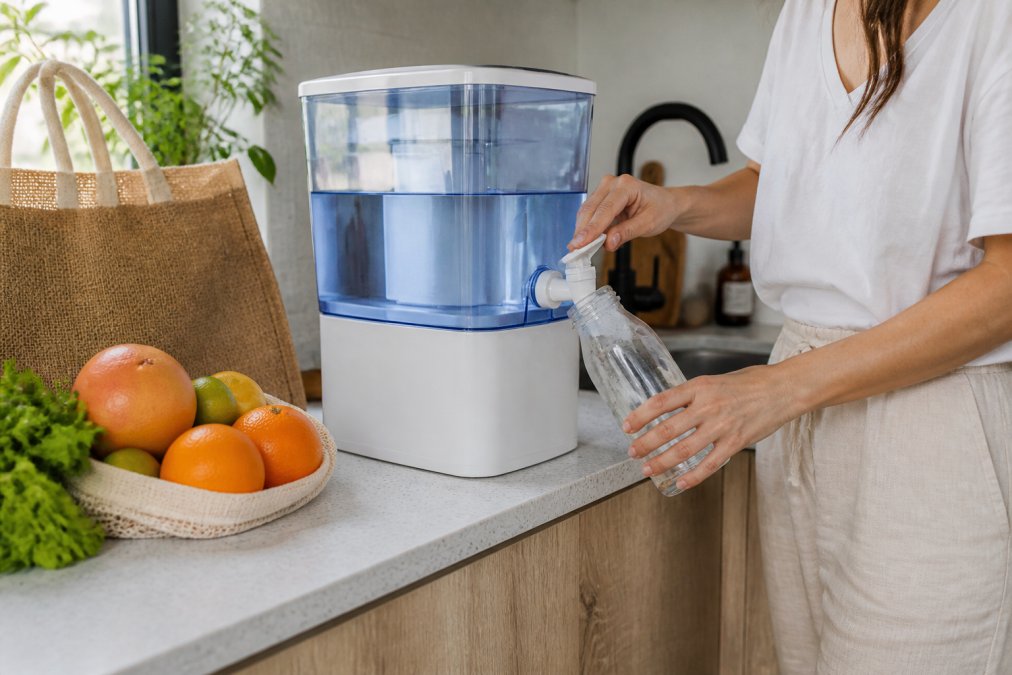
| System | Best for | Capacity | Price | Ongoing cost |
|---|---|---|---|---|
| AceBio+ Jug | Renters, small homes | 1.0 litre | £125.00 | Filter set included lasts up to 4,800 litres or up to 24 months |
| BIO 400 Bench Top | Families, workplaces | 5.25 litres | £329.00 | Filter set every 12-24 months |
| Mini BMP Waterman | Travel, gym, office | 600ml | £49.99 | Filters up to 300 litres |
Travel and Commuting: The Gap Most Guides Ignore
Home is the easy part. The habit breaks when you are away from your kitchen.
- Airports and stations. Security allows empty reusable bottles through. Fill at a post-security fountain or café; most UK airports have refill stations, so check the Refill app before you travel.
- Hotels. Fill from the bathroom tap if the local supply is safe, or ask reception for a filtered source. A portable filter bottle removes the guesswork.
- Work. Keep a dedicated bottle at your desk and refill from the kitchen tap or a filtered cooler. If your workplace only has bottled water, raise it with facilities.
- Commuting. A 600ml filter bottle in your bag covers the journey at a fraction of a station kiosk bottle's cost per litre.
- Eating out. Ask for tap water. UK licensed premises must provide free drinking water on request, so there is no reason to buy a bottle with your meal.
Build the Habit
Fill your bottle the night before, keep a spare at work and say no to the meal-deal bottle. Within two weeks the refill becomes automatic.
Common Mistakes When You Stop Buying Bottled Water
The biggest mistake is going cold turkey with no replacement in place. You will buy a bottle within days.
Get these four right and the switch sticks.
Frequently Asked Questions
Is filtered tap water cheaper than buying bottled water?
Yes, by a significant margin. A bench top filter like the BIO 400 works out at around 3 pence per litre once you account for the filter set, compared with roughly 50p to £1 per litre for branded bottled water. Over a year, a family of four drinking two litres each per day could spend over £1,400 on bottled water versus under £50 on filtered tap water.
How do I remove microplastics from tap water?
A filtration system with submicron technology and activated carbon is the most practical way to remove microplastics from tap water. The AceBio+ jug uses a 10-stage process including activated coconut shell carbon and a patented nano carbonate compound to filter out sediment, rust, bacteria, cysts, chlorine, chemicals, heavy metals, fluoride and unpleasant odours. Replace cartridges on schedule, because a spent filter cannot trap particles effectively.
What are the main benefits of water filtration systems?
The benefits of water filtration systems go beyond taste. They remove chlorine, heavy metals, fluoride and microplastics that can affect how water smells and tastes. Filtered water also works out far cheaper per litre than bottled, cuts single-use plastic waste, and gives you a consistent supply without storing heavy multi-packs. Some systems, like the BIO 400, also remineralise water with trace minerals.
I rent my home. Can I still stop buying bottled water?
Yes. Gravity-fed jugs and bench top systems need no plumbing, no electricity and no permanent installation. The AceBio+ 1.0 litre jug fits in a fridge door and filters up to 4,800 litres per filter set. The MyWaterJug 1.5 litre jug is another portable option at £64.99, filtering up to 300 litres per cartridge. Both are fully renter-friendly.