

Countertop Water Filter vs Bottled Water: 2026 Comparison
Table of Contents
- Countertop Water Filter vs Bottled Water: The Quick Comparison
- The Cost of Bottled Water vs Filtered Water UK
- How to Reduce Microplastics in Drinking Water
- The Benefits of Alkalised Water for Hydration and Recovery
- Filtration Technology: What Countertop Systems Actually Remove
- Maintenance, Storage and Long-Term Practicality
- Conclusion: Making the Switch That Fits Your Home
- Frequently Asked Questions
Last Updated: September 16, 2026
Countertop Water Filter vs Bottled Water: The Quick Comparison
The countertop water filter vs bottled water decision comes down to one uncomfortable fact: bottled water is a convenience product wrapped in a health halo, and most households pay heavily for it. At Waters Co, we have spent four decades building gravity-fed systems precisely because the alternative, trucking water home in plastic, makes little sense once you look at the numbers.
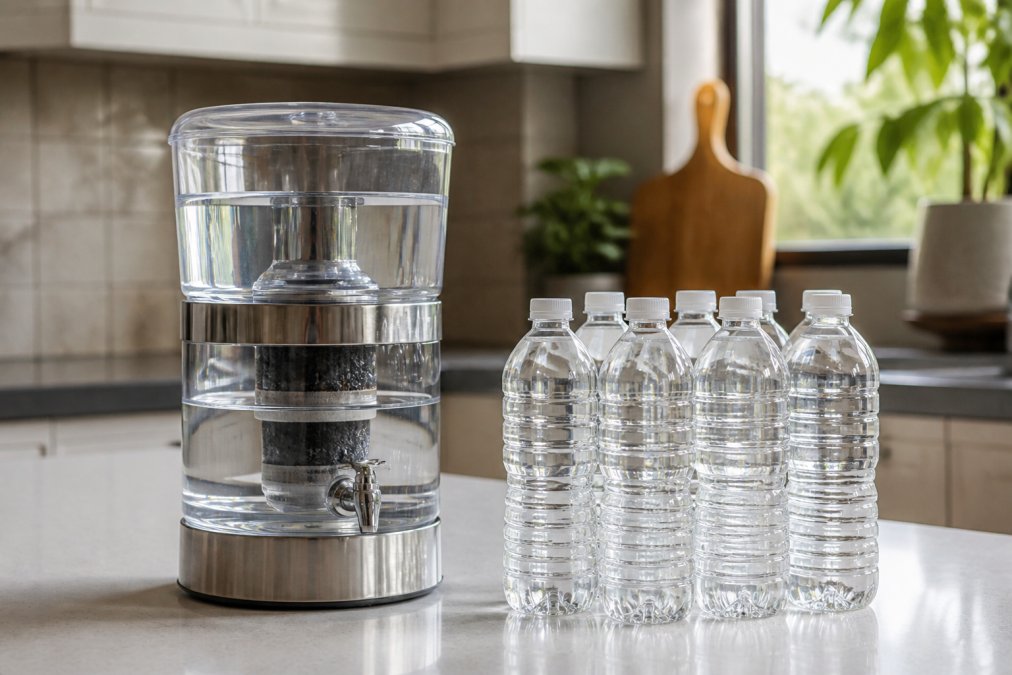
How the Two Options Stack Up
A countertop water filter is a gravity-fed or bench-top unit that sits on your work surface, requires no plumbing and no electricity, and filters tap water through multiple stages before you drink it. Bottled water is pre-packaged water, treated and sealed at a plant, then transported and stored before it reaches your fridge.
| Factor | Countertop Water Filter | Bottled Water |
|---|---|---|
| Upfront cost | One-off purchase | None |
| Ongoing cost | Filter replacements | Per-bottle, forever |
| Contaminant removal | Multi-stage, verified | Varies by brand |
| Plastic waste | None per litre | One bottle per serving |
| Storage | Refill at the unit | Bulk storage needed |
| Installation | None | None |
The Cost of Bottled Water vs Filtered Water UK
Filtered water costs a fraction of bottled water over any meaningful period, because you pay once for hardware and occasionally for cartridges rather than paying per serving. The gap is easiest to see when you model it per litre and per year rather than per bottle.
A Transparent Per-Litre Model
Take a household of two adults drinking two litres each per day, so four litres a day, roughly 1,460 litres a year.
| Cost element | Countertop filter | Bottled water |
|---|---|---|
| Upfront hardware | One-off purchase | None |
| Cost per litre (ongoing) | Around 3p | Roughly 20p to £1.30 |
| Annual cost at 1,460 litres | Around £44 in filters | Roughly £292 to £1,900 |
| Filter or bottle replacement | Every 12 to 18 months | Every serving |
| Storage and refrigeration | Refill at the unit | Fridge space for bulk packs |
What the Bottle Price Actually Contains
The shelf price of bottled water is not the cost of water. It is the cost of the bottle, the label, the cap, the transport, the refrigeration in the shop and the bin collection or recycling after use. When you buy a filter, you stop paying for all five of those line items and pay only for the water and the cartridge.
Total Cost of Ownership Over Five Years
Over five years, the same household drinks about 7,300 litres. Bottled water at 34p per litre is roughly £2,482; at £1.30 per litre it is roughly £9,490. A countertop system with a one-off purchase and filter replacements at around 3p per litre comes to roughly £220 in filters plus the initial hardware cost. Even allowing for a replacement unit partway through, the five-year gap remains structural rather than marginal.
How to Reduce Microplastics in Drinking Water
Reducing microplastics starts with the container and the storage conditions, not just the source. Microplastics are fragments under 5mm; nanoplastics are smaller still, below 1 micron. Both are now widely detected in bottled and tap water, and the mechanism of contamination matters more than the headline.
Three pathways drive plastic particle load in drinking water:
- Packaging contact: PET bottles can shed particles into the water they hold, and shedding increases with heat, sunlight, physical agitation and time in storage.
- Processing and transport: water passes through plastic pipes, fittings and tanks before it is sealed, so some particle load is present before the bottle is even filled.
- Storage after opening: once a bottle is opened and re-capped, repeated handling and warm storage accelerate particle release.
How Filtration Actually Captures Particles
Particle removal is a function of pore size, not marketing language. A filter's ability to capture microplastics depends on its smallest stage:
- Submicron pre-filtration: a stage rated below 1 micron physically blocks fine particulate matter, including many microplastic fragments, before water reaches the carbon.
- Activated carbon block: the dense carbon structure traps particles and adsorbs dissolved chemicals, including some plastic-associated compounds.
- Ion exchange and mineral media: these stages handle dissolved contaminants rather than particles, so they complement rather than replace mechanical filtration.
Practical Steps That Cut Your Exposure
- Switch from plastic bottles to glass or stainless steel containers
- Filter your tap water through a system with a defined submicron stage
- Avoid leaving bottled water in a hot car or direct sun
- Store filtered water in glass, not plastic, for anything beyond a day
- Check that your filter medium is BPA, BPB and BPS free
- Do not re-use single-use bottles for long-term storage
Waters Co's systems use BPA, BPB and BPS free construction with activated coconut shell carbon bonded with silver, which reduces common impurities including chlorine, chemicals and heavy metals. The submicron pre-filter stage is designed to capture fine particulate matter before the water reaches the carbon.
The Benefits of Alkalised Water for Hydration and Recovery
Alkalised water is water with a mildly raised pH, typically achieved by passing it through mineral media that adds calcium, magnesium and trace elements. The claimed benefits for hydration and athletic recovery centre on mineral content and how readily the body absorbs the water.
AceBio+ 1.0 Litre Alkaline Mineral →
Filtration Technology: What Countertop Systems Actually Remove
Countertop systems remove contaminants through staged media, and the stage count matters more than the marketing claim. A basic jug filter typically runs carbon only. A proper multi-stage bench top system layers pre-filtration, activated carbon, ion exchange and mineral media so each stage handles what the last one missed.
Key technologies worth understanding:
- Activated carbon: binds chlorine, chemicals and many heavy metals
- Nano activated carbon: targets fluoride, with up to 99% removal on Waters Co systems
- Ion exchange and mineral media: remineralises and adjusts pH
- Submicron pre-filtration: catches sediment, rust and cysts before the carbon stage
Comparing Multi-Stage Filtration to Bottled Water Standards
Bottled water in the UK is regulated as a food product, and the Drinking Water Inspectorate's guidance on water quality sets the standards that public supplies must meet. Bottled water must comply with its own food-safety rules, but the treatment it receives varies by brand and source. Some is filtered, some is spring water with minimal treatment, and the label rarely tells you the full process.
Maintenance, Storage and Long-Term Practicality
Maintenance on a countertop system is straightforward: replace the filter set on schedule and rinse the reservoir. Waters Co's BIO 400 and BIO 500 filter sets last up to 12,000 litres or 18 months, and a filter reminder service is available. The AceBio+ set lasts up to 4,800 litres or 24 months. The MyWaterJug cartridge lasts up to 300 litres or 90 days.
Conclusion: Making the Switch That Fits Your Home
The choice between a countertop water filter and bottled water is really a choice about what you are paying for. Bottled water sells convenience and charges you per litre forever. A countertop system asks for a one-off investment and then delivers water at a few pence per litre, with filtration you can actually see.
Frequently Asked Questions
Is it better to buy bottled water or a countertop water filter?
A countertop water filter wins on cost, environmental impact and contaminant control. Bottled water costs significantly more per litre and generates plastic waste. A countertop system like the BIO 400 filters up to 12,000 litres, removing up to 99% of chlorine, heavy metals, fluoride and microplastics while adding over 60 trace minerals. It works without plumbing or electricity, making it suitable for renters and homeowners alike.
How much money can you save by switching from bottled water to a countertop filter?
The cost of bottled water vs filtered water UK is stark. A family buying bottled water spends hundreds of pounds annually. A countertop filter like the BIO 400 costs £329 upfront but delivers water at around 3 pence per litre across its 12,000-litre filter life. That works out to roughly £360 for 12,000 litres compared to thousands for the equivalent volume in bottles.
Do countertop water filters remove microplastics effectively?
Yes. Multi-stage countertop filters use submicron pre-filter membranes and activated carbon to capture microplastics that bottled water can contain. Bottled water is not immune to microplastic contamination, as particles can leach from plastic packaging. Learning how to reduce microplastics in drinking water starts with filtration that physically blocks particles rather than storing water in plastic.
What are the benefits of alkalised water compared to bottled water?
Alkalised water from a countertop filter typically has a pH of 7.6 to 8.2. The benefits of alkalised water include better cellular hydration, mineral replenishment with calcium and magnesium, and support for recovery after exercise. Most bottled water is neutral or slightly acidic, and minerals vary by brand.
Is filtered tap water healthier than bottled water?
Filtered tap water removes chlorine, heavy metals, fluoride and bacteria while retaining beneficial minerals. Bottled water is regulated differently and can sit in plastic for months, risking chemical leaching. A countertop filter gives you control over water purity and lets you add back minerals. The World Health Organization notes that safe drinking water should be free from contaminants, which multi-stage filtration addresses directly.