

7 Essential Water Filtration Features for Active Households
Last Updated: November 7, 2026
Quick Summary
The essential water filtration features for active households are capacity, flow rate, contaminant coverage and upkeep cost. Size the reservoir to your morning draw, a family of four with two sporty teenagers can use 6-8 litres before 8am, and check the pressure assumption behind any quoted flow rate. Verify contaminant claims with independent test data and calculate cartridge replacement cost per litre before buying.
- A 7 litre bench top reservoir suits a busy household, while a 1.5 litre jug suits a single occupant or travel kit.
- Gravity-fed systems deliver a trickle rather than a stream, so reservoir size carries you through the morning rush.
- A £30 cartridge treating 1,500 litres costs 2p per litre; a £60 cartridge treating 6,000 litres costs 1p per litre.
- Filter sets rated up to 12,000 litres or up to 18 months spread running costs across daily use.
- A filter left past its rated life stops removing what it claims to remove, so set a reminder.
Table of Contents
- What Active Households Actually Need From a Water Filter
- What Do Water Filters Remove, and Which Contaminants Matter Most?
- Tap Water Quality Testing: Match the Filter to Your Supply
- Flow Rate and Capacity: Keeping Up With Simultaneous Use
- How to Find the Best Water Filter for Home Use
- Water Filter Cartridge Replacement and Total Cost of Ownership
- Choosing Your Filtration Setup With Waters Co
- Frequently Asked Questions
What Active Households Actually Need From a Water Filter
Most buying guides treat a household as a single, tidy unit. Real homes don't work that way. Households that use filtered water day to day tend to show the same pattern: demand spikes, not steady drips. Four people filling bottles before football practice, a kettle going on for the third time before nine, a jug emptied by lunchtime.
That's why the essential water filtration features for active households differ from what a solo occupant needs. A filter that trickles is a filter that gets abandoned.
The features that matter most are capacity, flow rate, contaminant coverage, and upkeep cost. Get those four right and the system earns its place on the counter. Get them wrong and it becomes another appliance gathering dust behind the bread bin.
Below, we break down what to check before you buy, and where most shoppers get caught out.
What Do Water Filters Remove, and Which Contaminants Matter Most?
Water filters reduce a range of contaminants, but not every filter handles every contaminant. Understanding what do water filters remove is the difference between buying the right system and buying a marketing promise.
Activated carbon is the workhorse. It adsorbs chlorine, which affects taste and odour, along with many organic compounds. Sediment filters catch rust, grit and particulate matter. Ion exchange targets dissolved minerals and heavy metals. Reverse osmosis pushes water through a semi-permeable membrane to remove dissolved solids (Physical removal of contaminants).
Multi-stage systems combine these methods. A multi-stage gravity-fed bench top unit runs water through several filtration and activation stages in sequence.
What should you prioritise?
- Chlorine and taste compounds if your water smells or tastes of the pool
- Heavy metals such as lead, particularly in older properties
- Microplastics and forever chemicals if you're concerned about long-term exposure
- Fluoride, which requires specific media rather than standard carbon
Check what your chosen filter actually claims to reduce, and against what evidence. More on that below.
Tap Water Quality Testing: Match the Filter to Your Supply
Your tap water is not the same as your neighbour's, and treating it that way is the most common mistake we see. Supply varies by region, by pipe age, and by whether your property has older plumbing.
Tap water quality testing is the step many shoppers skip. Your water supplier publishes a quality report for your area, which covers regulated parameters. That's a useful starting point. For a closer look at what's coming out of your kitchen tap, a home test kit or laboratory analysis can give you more detail on hardness, chlorine levels and dissolved solids.
Once you know your baseline, matching becomes straightforward:
- Hard water area? Look for ion exchange or softening capability.
- Noticeable chlorine taste? Prioritise high-grade activated carbon.
- Older property with lead pipework? Verify heavy metal reduction claims.
- Concerned about forever chemicals? Ask for third-party lab results, not just marketing language.
If you want a structured approach to sampling and interpreting results, our step-by-step guide to testing tap water quality walks through the process.
Watch out: buying a filter before you know your water profile often means paying for contaminant coverage you don't need while missing the one you do.
Flow Rate and Capacity: Keeping Up With Simultaneous Use
A filter's flow rate is how quickly it delivers water, usually quoted in litres per minute. Capacity is how much filtered water it holds ready to pour.
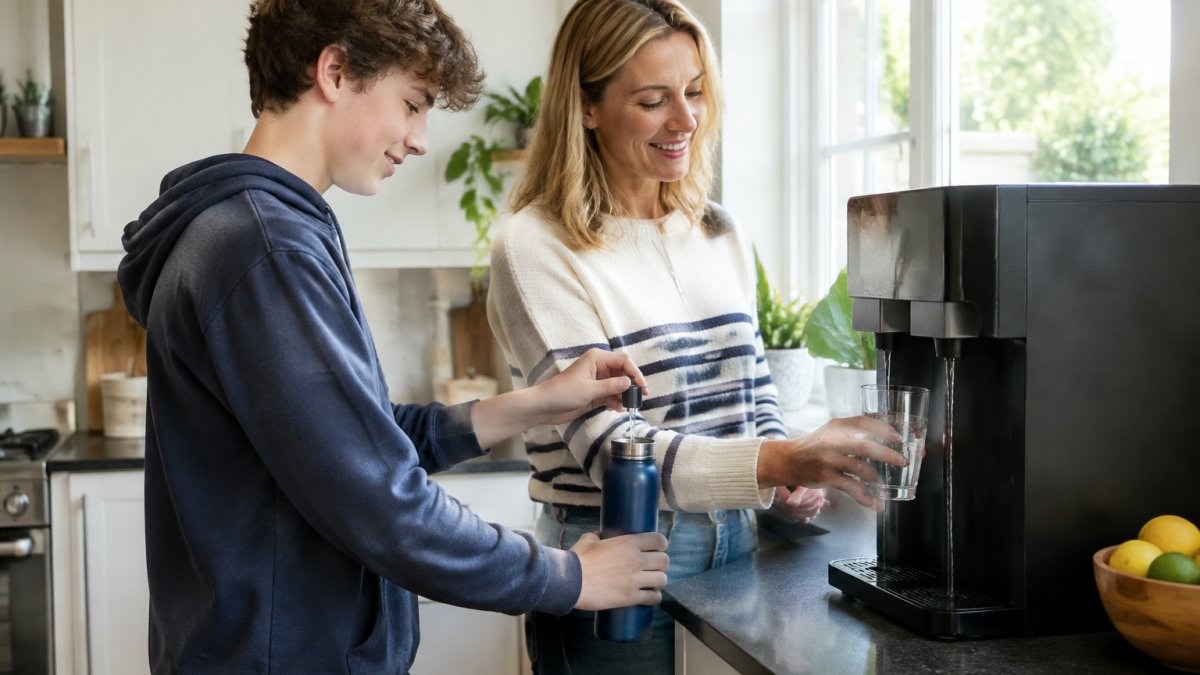
Here's the practical test. Count the people in your home who fill a bottle, a glass or a pan within the same twenty-minute window each morning.
Gravity-fed systems deliver water more slowly than plumbed-in units, typically a trickle rather than a stream, but they hold a reservoir of filtered water ready to use. That reservoir size is what carries you through the morning rush.
Plumbed-in point-of-use systems (under-sink or tap-mounted) quote a flow rate in litres per minute, but that figure is measured under specific pressure and temperature conditions.
Whole-house systems must be sized for peak simultaneous demand across all outlets, not average use. A system sized for one bathroom will struggle when two showers, a washing machine and a kitchen tap run at once.
For families, capacity also affects whether the system lives on the counter or in a cupboard. If your home runs at high volume, our guide to filtration for families covers the capacity question in more depth.
Watch out: a filter rated at a high flow rate may still disappoint if your incoming pressure is low or your pipework is narrow, check the pressure assumption behind the number before you buy.
Here are the capacity and flow figures the article uses to size a filter for real household demand.
| Item | Value | Note |
|---|---|---|
| Morning draw, family of four with two sporty teenagers | 6-8 litres before 8am | Determines reservoir size needed |
| Morning draw, couple working from home | About half that across the whole day | Lower volume, smaller capacity fine |
| Small jug capacity | 1.5 litres | Suits a single occupant or travel kit |
| Bench top reservoir capacity | 7 litres | Suits a busy household |
| Gravity-fed delivery | A trickle rather than a stream | Reservoir carries you through the rush |
| Plumbed-in flow rate | Quoted in litres per minute | Measured under specific pressure and temperature |
| Whole-house sizing | Based on number of bathrooms and expected peak flow | Must handle peak simultaneous demand |
How to Find the Best Water Filter for Home Use
Finding the best water filter for home comes down to matching four variables: your water quality, your household's daily volume, your space, and your budget over time. Price alone tells you very little.
Start with the format. Point-of-use filtration treats water at a single tap or countertop unit. Whole-house filtration treats everything entering the property, protecting appliances and pipework but costing considerably more to install and maintain. For most renters and many homeowners, point-of-use is the practical answer because it needs no plumbing work.
Then verify claims. Independent certification matters more than any specification sheet. Look for testing against recognised standards and ask to see the lab report behind a removal claim. A filter that states it removes a contaminant should be able to show you the test data.
We group household filters into three broad types:
- Filter jugs for low volume, portability and tight budgets
- Bench top gravity systems for families wanting higher capacity and multi-stage filtration without plumbing
- Under-sink and whole-house systems for permanent installations with higher upfront cost
For a side-by-side look at countertop models, our bench top water filter comparison shortlists specific systems against these criteria.
Water Filter Cartridge Replacement and Total Cost of Ownership
The purchase price is the smallest part of what a filter costs you. Water filter cartridge replacement is where the real money goes, and it's the number most buyers never calculate before committing.
Do the arithmetic before you buy:
- What does a replacement cartridge cost?
- How many litres does it treat?
- How many litres does your household use each week?
Divide the cartridge cost by its rated litre capacity, then multiply by your annual usage. That's your true running cost. A cheaper system with short-life cartridges can easily cost more over three years than a pricier unit with long-life filters.
Long-life filters change the equation. A filter set rated for up to 12,000 litres or up to 18 months spreads the cost across daily use.
Installation and maintenance add to the picture. Plumbed-in and whole-house systems may need professional installation, which carries a labour cost, and whole-house systems often require annual servicing. Gravity-fed bench top systems need no plumbing, so installation cost is zero, but you should factor in the time to refill the upper chamber and clean the system periodically.
Verifying cartridge life claims matters as much as the arithmetic. A stated capacity in litres is only meaningful if it's tested against a defined water quality and usage pattern. Ask the supplier what conditions the figure assumes: chlorine level, water hardness, and daily volume all affect real-world life.
For a fuller breakdown of running costs across system types, see our guide to long-term water filter maintenance costs.
Watch out: a filter left in place past its rated life stops removing what it claims to remove. Set a reminder, or use a system with a filter reminder service.
Choosing Your Filtration Setup With Waters Co
The right system is the one you'll actually keep using. For most active households, that means a bench top gravity system with enough capacity to survive the morning rush, multi-stage filtration that covers the contaminants you've identified, and a filter life long enough to keep running costs low.
At Waters Co, our bench top systems are built around exactly that brief. The BIO range uses 13 stages of filtration and activation, reducing up to 99% of sediment, rust, bacteria, cysts, chlorine, chemicals, heavy metals, fluoride and odours.
For a busy family, the BIO 500 MAX 7 litre bench top filter offers the largest reservoir in the range at £349.00, with a pH range between 7.6 and 8.5 and over 60 bio organic trace minerals. Smaller households may prefer the 5.25 litre BIO 400 at £329.00, or the portable ♥MyWaterJug at £64.99 for travel and lower-volume use. Every system carries a lifetime warranty.

If you're ready to choose a system for your household's actual demand, the Waters Co range is a good place to start.
Your water is either working for your family's health or quietly undermining it, and the difference usually comes down to whether you checked your supply before you bought. Waters Co builds multi-stage filtration systems that remove up to 99.9% of contaminants, alkalise and remineralise your water, and run on long-life filters backed by a lifetime warranty.
Frequently Asked Questions
What features should I look for in a home water filter?
Prioritise four things: what the filter removes (check for claims against contaminants you actually have), flow rate and capacity against your daily use, the replacement schedule and cost per litre, and independent certification. For busy homes, a system that needs no plumbing and no electricity, such as a gravity-fed bench top unit, removes installation barriers. Waters Co's BIO 400, for example, filters up to 99% of sediment, chlorine, heavy metals and fluoride across 13 stages and lasts up to 12,000 litres.
How often should you replace a water filter cartridge?
It depends on the system and your water. Jug filters typically last around 300 litres or three months, while larger gravity systems can run up to 12,000 litres or 18 months. Always follow the manufacturer's stated capacity rather than a calendar guess, and factor the cartridge cost into your yearly budget before buying. A filter reminder service helps, and Waters Co offers one alongside its filter sets.
Do water filter jugs remove contaminants as well as larger systems?
A well-built jug can remove a lot: the MyWaterJug uses a 7-stage cartridge that filters up to 99% of chlorine, fluoride, heavy metals, chemicals and bacteria while remineralising with around 60 trace minerals. The trade-off is capacity and filter life, at 1.5 litres and up to 300 litres per cartridge. Larger bench top systems give you more volume and longer cartridge life, so match the format to how much water your household drinks.
How can I check what is in my tap water?
Start with your water supplier's published quality report, which lists regulated parameters for your area. If you want detail on your own supply, order a laboratory test covering hardness, chlorine, heavy metals and dissolved solids. Use the results to pick a filter rather than guessing: a soft supply with high chlorine needs different treatment from a hard supply with sediment. Testing first also tells you whether a water filtration system is worth the spend at all.
