

Water Filtration System for Families: 2026 Guide
Table of Contents
- Why Families Are Rethinking Tap Water in 2026
- How Water Filtration Removes Contaminants and Impurities
- Water Filter Jug for Families: Portable and Rental-Friendly
- Under-Sink Water Filter for Family Kitchens
- Best Whole-House Water Filter for Families
- How Often to Change Water Filter Cartridges
- Choosing a Water Filtration System for Your Family's Needs
- Frequently Asked Questions
Last Updated: October 9, 2026
Why Families Are Rethinking Tap Water in 2026
A water filtration system for families has moved from nice-to-have to near-essential. At Waters Co, four decades of work on this problem have shown parents' questions changing: no longer just taste, but what is actually in the glass.
Your water supplier is legally required to deliver water that meets strict quality standards, and by and large it does. Residual chlorine keeps water safe as it travels through miles of pipe, but it also reaches your kitchen tap (Chlorine). The Drinking Water Inspectorate's annual report on water quality sets out what is tested and what is not, and it is worth reading alongside your supplier's own report.
What Your Water Supplier Doesn't Filter Out
Water treatment removes immediate health hazards, bacteria, viruses, much of the sediment, but not everything.
- Chlorine and chloramine remain in the water to keep it disinfected all the way to your home
- Lead can enter after treatment, from pipework and fittings
- Microplastics pass through conventional treatment processes
None of this means tap water is unsafe. It means "meets the standard" and "ideal for a family drinking several litres a day" are different questions.
How Water Filtration Removes Contaminants and Impurities
Filtration passes water through media that trap, bind, or chemically alter contaminants. Different media target different things, which is why a single-stage jug and a 13-stage bench top system are not interchangeable.
Sediment filtration is the first line of defence.
Activated carbon handles the bulk of everyday improvement. Coconut-shell carbon bonded with silver reduces chlorine, many chemicals, odours, and some heavy metals.
Submicron and nano-carbon stages go after harder targets. A patented nano carbon compound allows up to 99% fluoride reduction, which standard carbon cannot achieve.
Ion exchange swaps hardness minerals for softer ones, improving mouthfeel and protecting appliances. It does not remove chlorine or microbes.
What Each Technology Does and Does Not Remove
To read any filter claim neutrally, ask which contaminant class it addresses and whether the claim is verified against a recognised standard. The table below summarises typical performance, a starting point, not a guarantee. Always check the specific system's test data.
| Contaminant | Sediment | Activated carbon | Submicron / nano-carbon | Ion exchange | Reverse osmosis |
|---|---|---|---|---|---|
| Sediment, rust, particulate | Yes | Partial | Yes | No | Yes |
| Chlorine and chloramine | No | Yes (chloramine harder) | Yes | No | Yes |
| Taste and odour compounds | No | Yes | Yes | Partial | Yes |
| Lead | No | Partial | Partial | Partial | Yes |
| Fluoride | No | No | Yes (nano-carbon) | No | Yes |
| Hardness minerals (calcium, magnesium) | No | No | No | Yes | Yes |
| Bacteria and cysts | Partial | Partial | Yes | No | Yes |
| PFAS (per- and polyfluoroalkyl substances) | No | Partial | Partial | No | Yes |
| Dissolved minerals (re-mineralisation) | No | No | Adds back | Swaps | Strips, then re-adds if designed to |
Two caveats matter for families. First, "removes up to 99%" refers to a specific contaminant under specific test conditions, not everything in the water.
How to Read a Reduction Claim
Manufacturers describe performance differently, and the wording matters:
- "Reduces" generally means a measured percentage reduction under defined conditions.
- "Removes" is stronger and should be backed by test data.
- "Up to X%" is a ceiling, not a typical result.
For an independent view of what is tested in supply water and what is not, the Drinking Water Inspectorate's annual report on water quality is the authoritative starting point. It sets out the parameters regulators check and the ones they do not, which is often the gap a point-of-use filter is bought to close.
Sediment, Carbon and Submicron Stages Explained
Think of it as a sequence, not a single filter. Sediment catches the visible, carbon the chemical, submicron and nano stages the fine and dissolved. Remove any stage and the ones behind it work harder and fail sooner, the practical argument for multi-stage filtration over a cheap single-cartridge jug, provided each stage does a distinct job.
Water Filter Jug for Families: Portable and Rental-Friendly
A water filter jug is the simplest entry point, and for renters often the only realistic one: no plumbing, no landlord permission, no installation.
The ♥MyWaterJug 1.5L from Waters Co uses a single cartridge with seven stages of filtration and activation, filtering out up to 99% of chlorine, fluoride, heavy metals, chemicals, and bacteria while re-mineralising with around 60 bio-organic trace minerals.

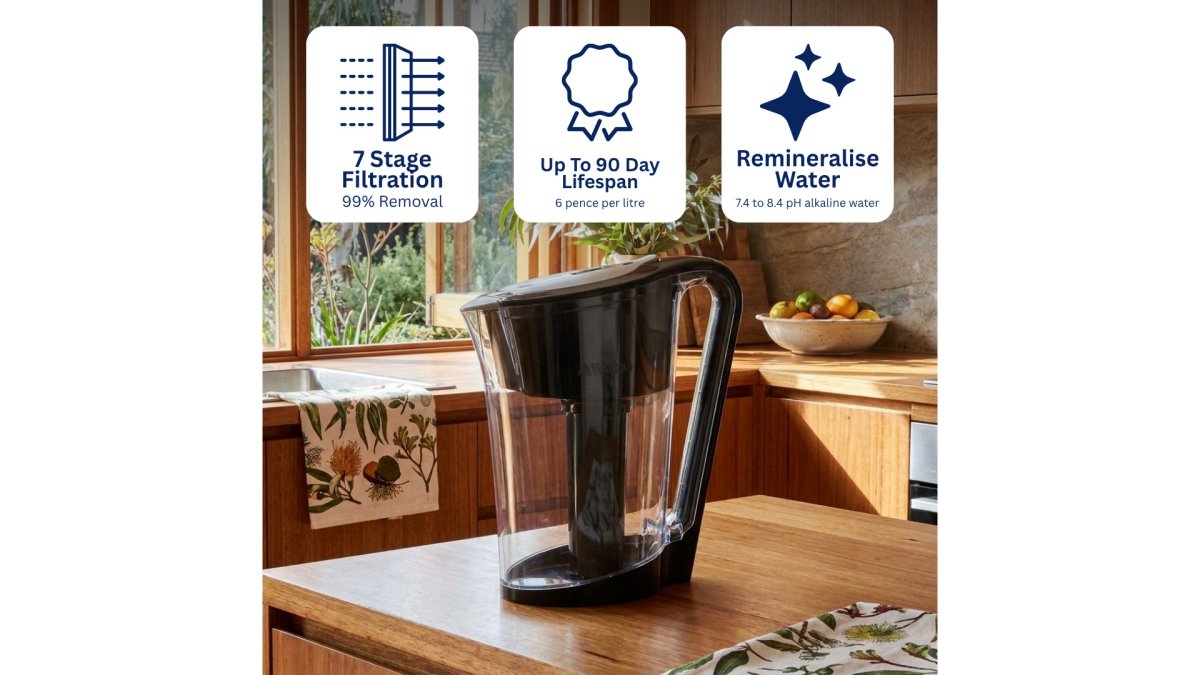
For a smaller footprint and a longer cartridge life, the AceBio+ 1.0 Litre jug (£125.00) runs ten stages and a filter set lasting up to 4,800 litres or 24 months.
Under-Sink Water Filter for Family Kitchens
An under-sink water filter for family use solves the refill problem by putting filtration out of sight and on tap: no jug to fill, no counter space lost, no waiting.
The trade-offs are real. Under-sink systems need installation, ruling out many rentals without landlord consent, plus a dedicated tap or diverter, and cartridge changes mean getting on your hands and knees.
Best Whole-House Water Filter for Families
A whole-house system treats every tap, shower, and appliance. For families, the appeal is consistency: the same water in the kitchen, the bathroom, and the washing machine.
Whole-house filtration costs more upfront, requires professional installation, and larger cartridges mean higher replacement costs. But it is the only option addressing shower and bathing water alongside drinking water, which matters for sensitive skin or chlorine sensitivity.
How Often to Change Water Filter Cartridges
Cartridge life depends on the system and your water. As a guide:
BIO 400 5.25 Litre Bench Top Water Filter →
| System Type | Typical Cartridge Life | Best For |
|---|---|---|
| Portable jug | Up to 300 litres / 3 months | Renters, one to two people |
| Larger jug | Up to 4,800 litres / 24 months | Small households, travel |
| Bench top | Up to 12,000 litres / 18 months | Families, daily drinking and cooking |
| Under-sink | Varies by model | Homeowners, high daily volume |
| Whole-house | Varies by model | Whole-property treatment |
Replace on schedule, not on taste. A cartridge that still tastes fine may have exhausted its capacity for contaminants you cannot taste. Check O-rings and seals at every change, and clean the housing to prevent bacterial growth.
The Family Cost of Ownership, Worked Through
Most guides stop at the purchase price.
Step 1: Estimate daily demand. Count drinking, cooking, kettle and coffee use. A rough figure is 1.5 to 2 litres per person per day.
Step 2: Convert to annual volume. Multiply daily demand by 365.
Step 4: Add the running costs. For each system, list:
- Purchase price
- Installation cost (zero for jugs and bench top, typically a call-out fee for under-sink and whole-house)
- Replacement cartridge or filter set price, multiplied by the number of changes over your chosen period
Step 5: Divide by litres produced. This gives cost per litre, the only figure that lets you compare a jug, a bench top, and a whole-house system fairly.
A worked example using the figures in this article:
| System | Purchase | Filter set life | Changes over 5 years | Cost per litre (approx.) |
|---|---|---|---|---|
| Portable jug | £64.99 | 300 litres / 3 months | ~20 | Higher per litre, lowest upfront |
| Larger jug | £125.00 | 4,800 litres / 24 months | ~2-3 | Lower per litre, small household only |
| Bench top | £329.00 | 12,000 litres / 18 months | ~3 | Around 3 pence per litre |
| Under-sink | Varies | Varies | Varies | Depends on model and installation |
| Whole-house | Varies | Varies | Varies | Highest upfront, treats all taps |
A Maintenance Routine That Survives Family Life
Cartridge changes are easy to forget until taste changes, by which point the media may be exhausted. A simple routine:
- Label the housing with the install date and the next change date.
- Set a calendar reminder at the interval the manufacturer specifies, whichever of volume or time comes first.
- Keep one spare cartridge or filter set in the cupboard so a change is never delayed by a delivery.
- Check O-rings and seals at every change and replace any that are cracked or stiff.
Choosing a Water Filtration System for Your Family's Needs
Match the system to your household, not the marketing. Start with three questions: how many litres does your family drink and cook with daily, do you rent or own, and what specifically concerns you about your water?
For most families, a bench top system hits the sweet spot. The BIO 400 5.25 Litre (£329.00) runs 13 stages of sterilising, filtration, and activation, removing up to 99% of sediment, rust, bacteria, cysts, chlorine, chemicals, heavy metals, fluoride, and odours.

Capacity, Flow Rate and Cost Per Litre
Capacity is where families get it wrong most often.
Cost per litre is the number worth calculating.
The right system is the one your family will actually use every day. Capacity you refill constantly and cartridges you forget to change will cost more in the long run than choosing slightly larger upfront.
Choosing a water filtration system for your family comes down to three things: what is in your water, how much you drink, and whether you can install anything permanent.
Waters Co has built multi-stage filtration systems since 1984, with a lifetime warranty, filter sets lasting up to 18 months, and construction free from BPA, BPB, and BPS.
Frequently Asked Questions
What type of water filtration system is best for a family?
It depends on your space and water use. A water filter jug for families suits renters and small households, with the MyWaterJug filtering up to 300 litres per cartridge. For larger families, a bench top system such as the BIO 400 holds 5.25 litres and its filter set lasts up to 12,000 litres or 18 months. Under-sink and whole-house systems suit homeowners wanting filtered water on tap throughout the property.
Is a whole-house water filter better than an under-sink filter?
A whole-house system treats every tap, so showers and appliances get filtered water too. An under-sink water filter for family kitchens only treats one outlet but costs less and is simpler to fit. If your main goal is drinking and cooking water, an under-sink or bench top unit covers it. Choose whole-house if you also want to reduce chlorine exposure in bathrooms and protect pipework.
What contaminants can a home water filter remove?
Multi-stage systems typically reduce sediment, rust, chlorine, heavy metals, bacteria, cysts and unpleasant odours. Waters Co systems use a patented nano carbon compound for up to 99% fluoride reduction, plus ion exchange and submicron filtration. Check the manufacturer's test results for specific contaminant claims, since performance varies by filter type and cartridge design.
Do families need a water filter if their tap water is treated?
Treated tap water meets safety standards, but treatment does not remove everything. Chlorine, lead from older pipework, microplastics and trace chemicals can remain. A filtration system gives you control over what ends up in your glass and improves taste and odour. For families using bottled water, filtering at home also cuts plastic waste and long-term cost.
How often should you replace a home water filter?
It varies by system. The MyWaterJug cartridge lasts up to 300 litres or 3 months. The AceBio+ filter set lasts up to 4,800 litres or 24 months. Bench top models like the BIO 400 and BIO 500 MAX run up to 12,000 litres or 18 months. Always check your manual, and replace sooner if flow rate drops or taste changes.
Are water filter jugs suitable for a family?
Yes, with caveats. A jug like the MyWaterJug holds 1.5 litres and filters up to 99% of chlorine, fluoride, heavy metals and bacteria across 7 stages. It suits small families or renters who cannot plumb in a system. Larger households may find refilling constant, so a 5.25 or 7 litre bench top model often works better for daily drinking and cooking.