

Best Countertop Water Filter for 2026: Top Picks Tested
Last Updated: October 22, 2026
Quick Summary
The best countertop water filter for 2026 depends on your household, but the BIO 400 is our flagship pick, running 13 stages of filtration with fluoride reduction up to 99% and a filter set lasting up to 12,000 litres or 18 months. Larger households should choose the 7 litre BIO 500 MAX, while renters and travellers can pick the AceBio+ or MyWaterJug.
- The BIO 400 costs £329.00 and carries a lifetime warranty.
- The BIO 500 MAX holds 7 litres and costs £349.00, just £20 more than the BIO 400.
- The AceBio+ filter set lasts up to 4,800 litres or 24 months.
- The MyWaterJug costs £64.99 and each cartridge lasts up to 300 litres or 3 months.
- A family of four drinking two litres each per day uses roughly 2,900 litres a year.
Table of Contents
- Why the Best Countertop Water Filter for 2026 Matters
- Top Countertop Water Filters Compared
- Countertop Reverse Osmosis Water Filter: What to Know Before Choosing
- Countertop Water Filter Without Installation: Plug-and-Pour Options
- Water Filter Cartridge Replacement: Lifespan and What to Expect
- Countertop Water Filter Running Costs: The Real Annual Expense
- Which Countertop Water Filter Should You Pick?
- Frequently Asked Questions
Why the Best Countertop Water Filter for 2026 Matters
Tap water quality has become a genuine household concern, and the best countertop water filter for in 2026 has to earn its place on your worktop.
Three things separate a good countertop unit from a weak one: verified contaminant reduction, honest running costs, and whether it fits your kitchen without plumbing. Get those right and you avoid the common mistake of paying for filtration that never touches the contaminants in your supply.
Top Countertop Water Filters Compared
The four systems below cover the full range: two large bench top gravity filters, one mid-size alkaline jug, and one budget portable jug. Each uses multi-stage filtration rather than a single carbon block, and each runs without electricity or a tap connection.
| Model | Capacity | Price | Filter Life | Best For |
|---|---|---|---|---|
| BIO 400 | 5.25 L | £329.00 | Up to 12,000 L or 18 months | Families wanting fluoride reduction |
| BIO 500 MAX | 7 L | £349.00 | Up to 12,000 L or 18 months | Larger households, black finish |
| AceBio+ | 1.0 L | £125.00 | Up to 4,800 L or 24 months | Travel and smaller kitchens |
| MyWaterJug | 1.5 L | £64.99 | Up to 300 L or 3 months | Budget and portability |
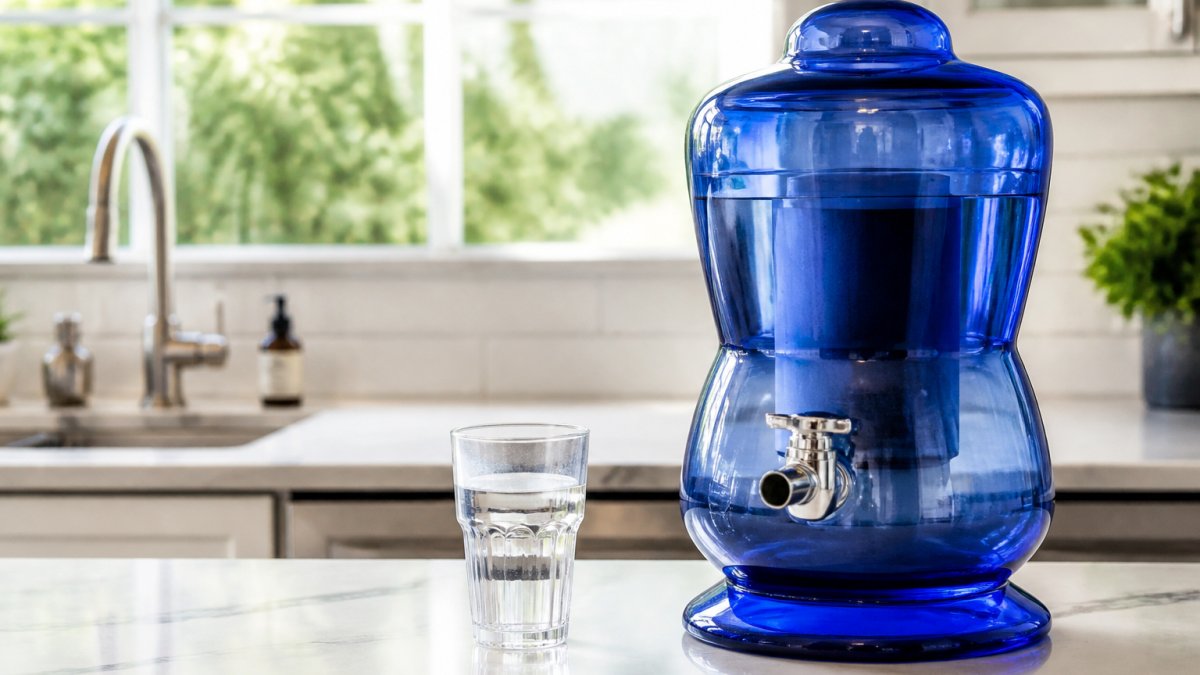
BIO 400 5.25 Litre Bench Top Water Filter
Our flagship pick, and the one we recommend most often. The BIO 400 runs 13 stages of sterilising, filtration and activation, including a patented nano carbon compound for fluoride reduction up to 99% removal. It filters out up to 99% of sediment, rust, bacteria, cysts, chlorine, chemicals, heavy metals and unpleasant odours.

The hand-blown blue silica glass reservoir holds 5.25 litres, which suits a family kitchen. The included filter set lasts up to 12,000 litres or 18 months, and the unit carries a lifetime warranty. It adds over 60 bio-organic trace minerals and typically lands around pH 7.6 to 8.2.
BIO 500 MAX 7 Litre Bench Top Water Filter
Same 13-stage engine as the BIO 400, but with a 7 litre reservoir and a black finish. If you fill bottles for the whole household each morning, the extra capacity means fewer refills. Price sits at £349.00, just £20 above the BIO 400.
It shares the fluoride reduction, the 12,000-litre filter life, the lifetime warranty, and the BPA, BPB and BPS free construction. The pH range is quoted at 7.6 to 8.5.
AceBio+ 1.0 Litre Alkaline Mineral Water Filter Jug
The AceBio+ is the middle option, and it suits renters who move often. Ten stages of filtration handle sediment, rust, bacteria, cysts, chlorine, chemicals, heavy metals and fluoride, with the same patented nano activated carbonate compound for fluoride reduction.
Its filter set lasts up to 4,800 litres or 24 months, which is the longest cartridge life per unit in this group. At £125.00 it sits between the jugs and the bench top systems, and it adds around 60 bio-organic trace minerals.
MyWaterJug 1.5L Water Filter
The budget entry, and a genuine option rather than a token one. Seven stages of filtration and activation remove up to 99% of chlorine, fluoride, heavy metals, chemicals and bacteria, and it re-mineralises with around 60 trace minerals.
At £64.99, it is the cheapest way into multi-stage filtration. Each cartridge lasts up to 300 litres or about three months, and one filter replaces up to 330 single-use 600ml bottles. It is BPA, BPB and BPS free and needs no electricity or tap connection.
Countertop Reverse Osmosis Water Filter: What to Know Before Choosing
A countertop reverse osmosis water filter pushes water through a membrane fine enough to remove dissolved contaminants, including many that carbon filters miss. It is the most thorough option for nitrate, arsenic and PFAS reduction, but it comes with trade-offs worth understanding before you buy, and most buying guides skip the practical ones.
Reject water. RO membranes work by forcing water through a semi-permeable barrier and flushing the concentrated contaminants away as reject water.
Mineral retention. RO strips minerals along with contaminants, so remineralisation matters if you want the taste and mouthfeel of mineral water.
Energy and pressure. Many countertop RO units need mains pressure or an internal pump, which means a power connection and a small ongoing electricity draw.
When RO is genuinely justified. Choose reverse osmosis only when your water report shows dissolved contaminants that carbon cannot address, high nitrate from agricultural runoff, arsenic, or elevated PFAS.
A practical way to decide: request your supplier's water quality report or a test from an accredited laboratory, look for the specific contaminants above, and only then compare RO against gravity-fed multi-stage filtration on the contaminants you actually have. The best countertop water filter for in 2026 is the one matched to your supply, not the one with the longest feature list.
BIO 400 5.25 Litre Bench Top Water Filter →
Countertop Water Filter Without Installation: Plug-and-Pour Options
A countertop water filter without installation works straight out of the box: fill the top reservoir, let gravity pull water through the filter medium, and draw from the lower chamber. No plumber, no drilling, no permanent change to your kitchen.
All four systems above work this way. The BIO 400 and BIO 500 MAX use gravity-fed filtration through 13 stages. The AceBio+ and MyWaterJug use the same principle in jug form. None needs electricity or a tap connection, which makes them suitable for rented homes, caravans and offices.

Setup takes minutes: rinse the filter set, seat it in the housing, fill and discard the first cycle, then refill. The filter reminder service on the bench top models helps you track replacement without guessing.
Water Filter Cartridge Replacement: Lifespan and What to Expect
Cartridge lifespan varies more than any other spec, and it drives your real cost. Here is what each model expects:
- BIO 400 and BIO 500 MAX: up to 12,000 litres or 18 months per filter set
- AceBio+: up to 4,800 litres or 24 months per filter set
- MyWaterJug: up to 300 litres or 90 days per cartridge
Lifespan assumes typical municipal water. Harder water or heavier daily use shortens it, so track your fill rate rather than the calendar alone. A family of four drinking two litres each per day uses roughly 2,900 litres a year, well inside the bench top models' capacity.

Replacement is self-service on every model: lift out the old cartridge or filter set, seat the new one, run a rinse cycle. The MyWaterJug takes refill packs of three cartridges.
Countertop Water Filter Running Costs: The Real Annual Expense
Running costs separate the cheap-looking option from the genuinely economical one, and the only honest way to compare is total cost of ownership over several years.
The table below models a household of four drinking two litres each per day, roughly 2,900 litres a year, using each model's rated filter life and the replacement prices quoted for its filter sets and cartridges. Treat the replacement figures as the current listed prices and check them at the point of purchase, because consumable pricing moves more often than hardware pricing.
| Model | Upfront | Rated Filter Life | Replacements Over 3 Years | Estimated 3-Year Consumable Cost | Approx. Cost per Litre |
|---|---|---|---|---|---|
| BIO 400 | £329.00 | Up to 12,000 L or 18 months | 2 filter sets | £180.00 | About 2p |
| BIO 500 MAX | £349.00 | Up to 12,000 L or 18 months | 2 filter sets | £180.00 | About 2p |
| AceBio+ | £125.00 | Up to 4,800 L or 24 months | 2 filter sets | £100.00 | About 2p |
| MyWaterJug | £64.99 | Up to 300 L or 3 months | 12 cartridges (4 three-packs) | £120.00 | About 2p |
Those consumable figures are illustrative and assume typical municipal water; harder water or heavier use shortens cartridge life and raises the per-litre figure. The pattern is consistent: pay more upfront for longer cartridge life, or pay less and replace more often.
The comparison that matters most is against bottled water. At typical supermarket prices, bottled still water works out many times more expensive per litre than any of these systems.
Which Countertop Water Filter Should You Pick?
Match the system to your household rather than the other way round.
Renters and frequent travellers are better served by the AceBio+ or MyWaterJug.
If your water report shows high nitrate or arsenic, investigate reverse osmosis first. For everything else, gravity-fed multi-stage filtration covers the contaminants most households actually face.
The challenge is simple: most countertop filters look alike on the shelf but differ sharply in what they remove and what they cost across a year.
Frequently Asked Questions
How often should you replace a countertop water filter cartridge?
Replacement intervals depend on the model and how much water you use. The BIO 400 and BIO 500 filter sets last up to 12,000 litres or 18 months, while the AceBio+ lasts up to 4,800 litres or 24 months. The MyWaterJug cartridge needs changing every 300 litres or roughly 90 days. Always check the manufacturer's stated capacity rather than calendar dates alone, because hard water or heavy daily use shortens cartridge life.
Do countertop water filters need to be installed?
No. Gravity-fed countertop water filters need no plumbing, electricity or tap connection. You fill the reservoir by hand, water passes through the filter stages, and it collects in the lower chamber ready to pour. This makes them suitable for renters, caravans and offices where drilling into a worktop is not possible. Setup takes minutes: rinse the filter, assemble the housing and fill it.
How much does it cost to run a countertop water filter?
Running costs come down to replacement cartridges. With Waters Co bench top systems, the included filter set lasts up to 12,000 litres, which works out at around 3 pence per litre. Compare that with bottled water, where a 600ml bottle typically costs far more per litre. Factor in the upfront price, filter replacements and any reminder service when comparing models, and calculate cost per litre rather than sticker price alone.
Which contaminants can a countertop water filter remove?
Multi-stage gravity filters reduce a broad range of contaminants. Waters Co systems filter out up to 99% of sediment, rust, bacteria, cysts, chlorine, chemicals, heavy metals, fluoride and unpleasant odours, using a patented nano carbon compound for fluoride reduction. Performance varies by model, so check the stated contaminant list and any independent test results for the specific unit you are considering rather than assuming all countertop filters perform the same.
Are countertop reverse osmosis filters better than carbon filters?
They solve different problems. Countertop reverse osmosis removes a very wide range of dissolved contaminants but typically wastes water in the process and strips beneficial minerals, which then need remineralising. Carbon and multi-stage gravity filters target chlorine, chemicals, heavy metals, fluoride and odours while retaining or adding minerals. If your priority is mineral-rich alkaline water without wastewater, a gravity-fed multi-stage system is often the more practical choice.