

Best Fluoride Removal Water Filter 2026: Top Picks
Table of Contents
- Best Fluoride Removal Water Filter 2026: Comparison Table
- AceBio+ 1.0 Litre Alkaline Mineral Water Filter Jug: Best for Renters and Small Spaces
- BIO 400 5.25 Litre Bench Top Water Filter: Best All-Rounder for Families
- BIO 400 MAX 7 Litre Bench Top Water Filter: Best for Larger Households
- BIO 500 5.25 Litre Bench Top Water Filter: Best Black Edition for Modern Kitchens
- BIO 500 MAX 7 Litre Bench Top Water Filter: Best Large-Capacity Black Edition
- How to Verify Water Filter Lab Testing Before You Buy
- Does Brita Remove Fluoride? What Jug Filters Really Do
- Frequently Asked Questions
Last Updated: October 7, 2026
Best Fluoride Removal Water Filter 2026: Comparison Table
Most jug filters leave fluoride almost untouched, so many households still buy bottled water despite owning a filter.
Fluoride removal reduces dissolved fluoride ions in drinking water through a filtration medium that binds or traps them. Standard carbon-only jugs do not do this.
Here is the short version before the detail:
| Model | Capacity | Price | Best For | Filter Life |
|---|---|---|---|---|
| AceBio+ Jug | 1.0 litre | £125.00 | Renters, small spaces, travel | Up to 4,800 litres / 24 months |
| BIO 400 | 5.25 litres | £329.00 | Families wanting the best all-rounder | Up to 12,000 litres / 18 months |
| BIO 400 MAX | 7 litres | £349.00 | Larger households | Up to 12,000 litres / 18 months |
| BIO 500 | 5.25 litres | £329.00 | Modern kitchens, black finish | Up to 12,000 litres / 18 months |
| BIO 500 MAX | 7 litres | £349.00 | Large households, black finish | Up to 12,000 litres / 18 months |
If you rent, cannot plumb anything in, or want a jug that fits a fridge door, the AceBio+ is the practical answer.

AceBio+ 1.0 Litre Alkaline Mineral Water Filter Jug: Best for Renters and Small Spaces
The AceBio+ needs no bench space. It holds 1.0 litre and fits a fridge shelf or a suitcase, the sensible choice if you rent, move often or travel.
It runs 10 stages of sterilising, filtration and activation.
The filter set lasts up to 4,800 litres or 24 months, and cartridges are replaceable. Construction is BPA, BPB and BPS free.
Where it falls short: 1.0 litre is a personal supply, not a family one. A household of four will refill it constantly, so step up to a bench top model.
BIO 400 5.25 Litre Bench Top Water Filter: Best All-Rounder for Families
The BIO 400 is the model we recommend most often.

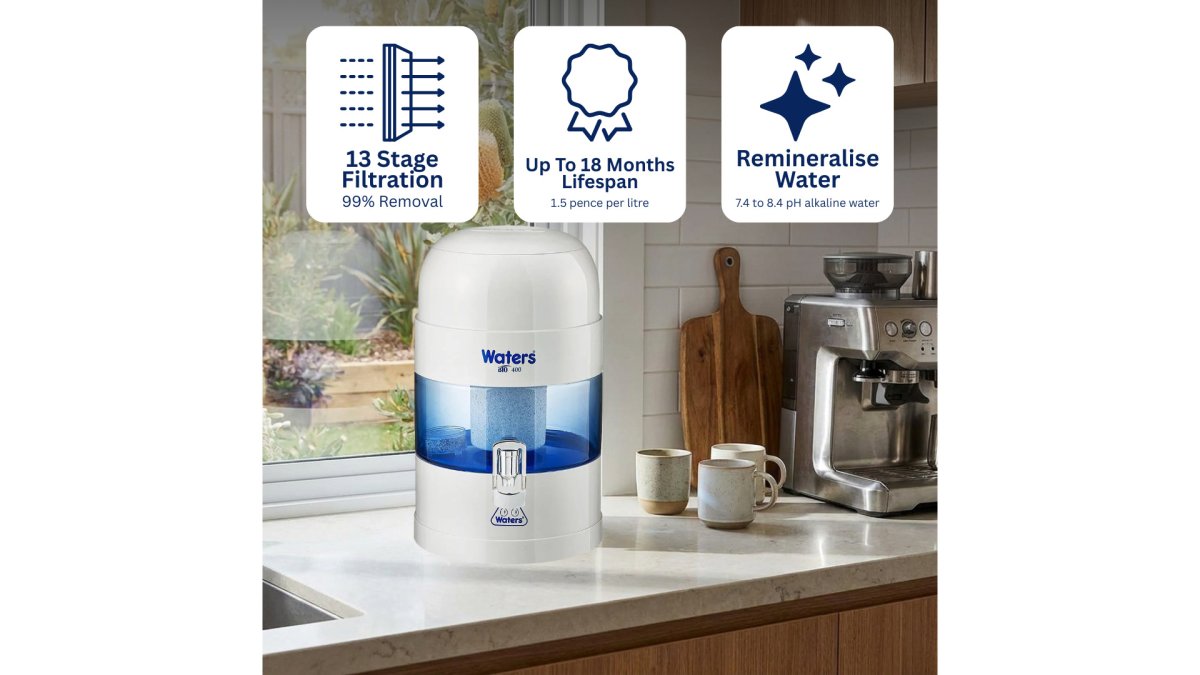
What sets it apart from a standard carbon jug is the medium used for fluoride: a patented nano carbon compound rather than activated alumina.
The reservoir is hand-blown blue silica glass, which keeps water fresh. There is no electricity and no tap connection. It stands 385mm tall with a 235mm base and weighs 4.2kg, so it needs a dedicated spot rather than a cupboard.
Every Waters Co bench top unit carries a lifetime warranty, and the construction is BPA, BPB and BPS free. At £329.00, the BIO 400 is the model we would buy for a family of three to four.
BIO 400 MAX 7 Litre Bench Top Water Filter: Best for Larger Households
Two extra litres sounds trivial until you are cooking, filling bottles and making tea in the same hour.
The honest trade-off is footprint: seven litres of glass and water needs a worktop that can spare the space permanently.
For households of five or more, or anyone filling multiple bottles a day, the MAX removes the constant refilling that makes people abandon gravity filters.
BIO 500 5.25 Litre Bench Top Water Filter: Best Black Edition for Modern Kitchens
The BIO 500 is the BIO 400 in black: same 13 stages, 5.25 litre capacity, £329.00 price and 12,000-litre filter life.

Performance is identical: patented nano carbon fluoride reduction, over 60 bio-organic trace minerals, organic germanium, the Alkalite Diskette producing far infrared, and bio ceramic in the tank keeping water fresh.
What most buyers miss is that colour is the only variable. You are not paying a premium for the black edition, and you are not sacrificing anything either.
Choose this over the BIO 400 purely on how it looks in your kitchen. There is no technical reason to prefer either.
BIO 500 MAX 7 Litre Bench Top Water Filter: Best Large-Capacity Black Edition
The BIO 500 MAX combines the two upgrades: the black finish and the 7 litre reservoir, at £349.00. It is the largest system here and the one to pick for maximum stored capacity without a grey unit on the counter.
Where it makes sense: busy kitchens where multiple people draw water at once, and households already buying bottled water in bulk. Where it does not: small flats, or anyone who wants the filter out of sight between uses.
How to Verify Water Filter Lab Testing Before You Buy
Most fluoride-removal pages make a percentage claim and move on, rarely showing the method behind it.
AceBio+ 1.0 Litre Alkaline Mineral Water Filter Jug →
Ask the seller for the test report itself, not a summary.
Here is the checklist we would run through before buying any filter:
- Does the product state a specific fluoride reduction figure, not just "removes impurities"?
- Is the filtration medium for fluoride named, such as nano activated carbon or activated alumina?
- Will the seller provide a third-party lab report on request?
That last point matters more than people expect. Certifications are not interchangeable, and none automatically proves a fluoride reduction percentage:
- CE marking is a declaration that a product meets applicable health, safety and environmental requirements for sale. It is not a contaminant-performance test.
- UKCA marking performs the same conformity role for goods placed on the market here. Again, it says nothing about how much fluoride a filter removes.
- ISO standards such as ISO 9001 cover quality management systems, how consistently a business operates, not the performance of a specific cartridge.
So when a page says "certified", ask: certified to what, by whom, and for which contaminant?
Once you have the report, compare it with your own supply. Your water supplier publishes an annual water quality report showing the fluoride level in your area, and the Drinking Water Inspectorate regulates those supplies and publishes its findings. Look up your local figure first: if your supply sits at a low level, a modest reduction may be all you need; if it is higher, you want a documented, contaminant-specific figure you can hold the brand to.
A practical way to sanity-check any claim is to ask what happens at the end of filter life.
Does Brita Remove Fluoride? What Jug Filters Really Do
Standard Brita-style jug filters use activated carbon and ion exchange resin. That combination reduces chlorine, taste and odour compounds, and some heavy metals, but it is not designed to remove fluoride.
This is the part most guides get wrong. They treat all jug filters as equivalent and rank them on price and taste.
"Filtered water" is a category, not a guarantee. A filter that removes chlorine beautifully can leave fluoride almost entirely in place.
Which medium actually removes fluoride?
Fluoride is a small, charged ion, which is why it slips through carbon. The media that genuinely bind it fall into a few families, and each has trade-offs:
- Activated alumina is the most widely studied fluoride medium. It works by ion exchange, but its capacity drops as pH rises, it can release aluminium if poorly managed, and it needs careful regeneration or replacement.
- Nano activated carbon and modified carbon compounds bind fluoride alongside other contaminants in a single cartridge, which suits gravity systems where you want one filter set to do several jobs.
- Reverse osmosis removes fluoride very effectively because the membrane rejects dissolved ions, but it also strips beneficial minerals, produces wastewater, needs water pressure or a pump, and typically requires remineralisation afterwards if you want the water to taste and behave like drinking water.
That is the honest trade-off: a gravity jug wins on convenience and cost per litre; reverse osmosis wins on removal breadth but costs more to run, wastes water and needs remineralisation; under-sink and whole-house systems sit between the two depending on how much you want to plumb in.
Choosing by household and installation needs
Rather than ranking products, work backwards from your situation:
- Renting, small space, or travel: a gravity jug or countertop unit. No plumbing, no power, and you can take it with you. Expect lower capacity and more refilling.
- Family kitchen, no plumbing changes wanted: a bench top gravity system with a larger reservoir. You trade counter space for capacity and a lower cost per litre.
- Under-sink installation possible: a point-of-use system frees the worktop and can combine sediment, carbon and a fluoride-specific stage. You need cabinet space and a tap or drain connection.
- Whole-house treatment: only worth considering if you want fluoride reduction at every outlet, and it is the most expensive to buy, install and maintain. Most households do not need it for drinking water alone.
Total ownership cost, not sticker price
The number that matters is cost per litre over the life of the system, not the price on the box. Divide the purchase price plus every replacement cartridge you will buy over, say, five years, by the total litres those cartridges are rated to treat. A cheap jug with frequent, pricey cartridges can cost more per litre than a bench top system with a long-life filter set.
Remineralisation and performance trade-offs
If you go the reverse osmosis route, the water that comes out is close to demineralised. Many households add a remineralisation stage to restore calcium, magnesium and trace minerals, partly for taste and partly because mineral-free water can taste flat.
If you want to reduce fluoride and keep the convenience of a jug, the AceBio+ is the direct answer. If you want higher capacity and a lower cost per litre, a bench top model does the same job at scale.
Frequently Asked Questions
Which water filter is most effective at removing fluoride?
Effectiveness depends on the filtration method. Reverse osmosis systems and filters using a dedicated fluoride-reduction stage, such as the patented nano activated carbonate compound in Waters Co bench top systems, are designed to remove up to 99% of fluoride. Standard carbon-only jugs are not built for fluoride reduction. Always check the product's stated removal rate and whether it has independent lab testing before buying.
Will a Brita water filter remove fluoride?
No. Standard Brita jug filters use activated carbon and ion exchange resin to reduce chlorine, limescale and some heavy metals, but they are not designed to remove fluoride. If fluoride reduction is your priority, look for a filter with a dedicated fluoride-reduction stage, such as the AceBio+ jug or the BIO 400 bench top range, and check the stated removal rate.
How can I verify a water filter's fluoride removal claims?
Ask for third-party lab test reports that name the testing method and the water conditions used. Check whether the claimed removal rate is for fluoride specifically or for a broader contaminant group. If a brand cannot supply test documentation, treat the claim with caution.
How often should a fluoride filter cartridge replacement be done?
It depends on the system and your water usage. The AceBio+ jug filter set lasts up to 4,800 litres or 24 months, while the BIO 400 and BIO 500 filter sets last up to 12,000 litres or 18 months. These figures assume typical municipal water; hard water or heavy daily use can shorten filter life. Most brands offer a filter reminder service, and replacing on schedule protects both performance and taste.
Is there a water filter that removes fluoride completely?
No consumer filter removes 100% of fluoride in every water supply. The best systems, including reverse osmosis and multi-stage filters with a dedicated fluoride-reduction stage, can reduce fluoride by up to 99% under tested conditions. That is a very high reduction, but the exact figure depends on your water's fluoride level, pH and the filter's condition. Testing your tap water gives you a clear baseline.