

How to Remove PFAS From Tap Water at Home in 2026
Table of Contents
- What You'll Need Before You Start
- Step 1: Check Whether Your Tap Water Contains PFAS
- Step 2: Reverse Osmosis vs Activated Carbon for PFAS Removal
- Step 3: How to Verify Water Filter Lab Testing Before You Buy
- Step 4: Check PFAS Water Filter Certification Standards
- Step 5: Choose Your System and Install It
- Common Mistakes to Avoid When You Remove PFAS From Tap Water
- Frequently Asked Questions
Last Updated: September 20, 2026
What You'll Need Before You Start
PFAS, or per- and polyfluoroalkyl substances, are man-made chemicals that resist heat, water and oil. They are called forever chemicals because they break down very slowly. This guide from Waters Co shows you how to remove PFAS from tap water at home, step by step.
You do not need to be a plumber or a chemist. You need the right tools and a clear plan. Here is what to gather before you begin:
- A water test result or a water quality report
- A filter system that states PFAS removal on its label
- A spare jug or container for filtered water
- A calendar reminder for cartridge changes
The Drinking Water Inspectorate guidance on PFAS explains how water companies monitor these chemicals. In the UK, tap water must meet strict safety standards set by the Drinking Water Inspectorate.
Step 1: Check Whether Your Tap Water Contains PFAS
Start by finding out what is actually in your water. Most water companies publish an annual water quality report for your postcode. You can also order a home test kit online or from a lab.
Test for the most common types: PFOA, PFOS and GenX. Results are usually given in parts per trillion (ppt). Even tiny amounts matter, so a proper lab test gives you a real number to work from.
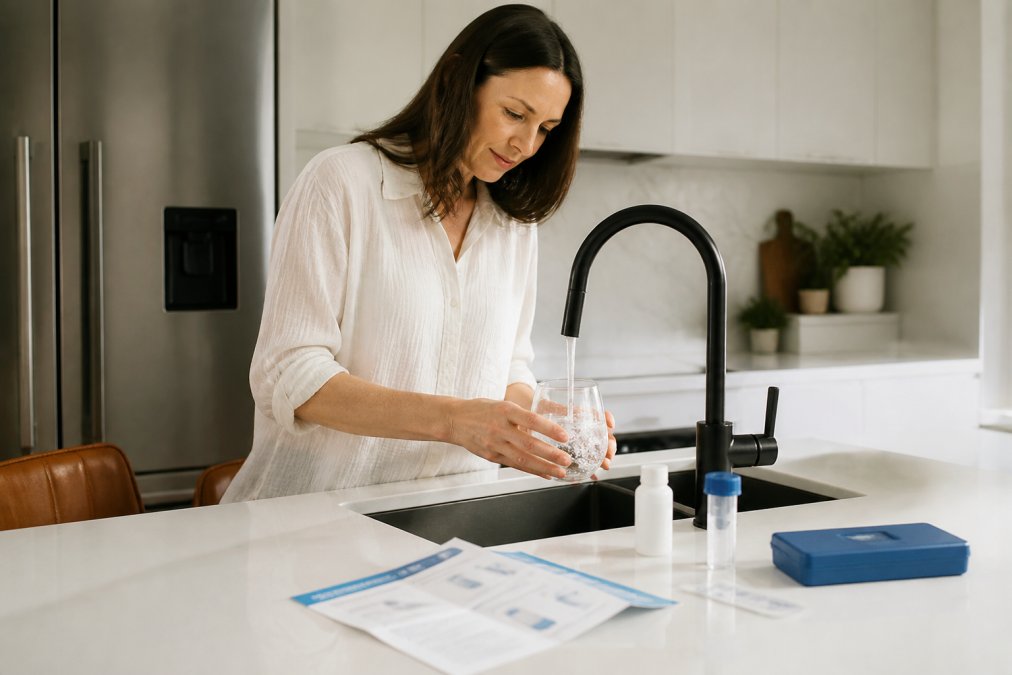
Water Quality Testing for PFAS
Water quality testing for PFAS checks your supply for specific chemicals at very low levels. A lab test is more accurate than a strip test. Send a sample away and you will get a clear reading within a couple of weeks.
If you have a private well, testing matters even more. Wells are not covered by the same rules as mains water, so the owner is responsible for checking quality.
Step 2: Reverse Osmosis vs Activated Carbon for PFAS Removal
Two systems do most of the heavy lifting: reverse osmosis and activated carbon. Each works differently, and each suits different homes.
Reverse osmosis pushes water through a semipermeable membrane. The membrane blocks PFAS, heavy metals and other contaminants. Water that passes through is called permeate, while the waste stream is called brine.
Activated carbon traps chemicals through a process called adsorption. Carbon filters are cheap and easy to fit, but they vary a lot in how well they catch shorter-chain PFAS.
| Method | How It Works | Best For | Trade-off |
|---|---|---|---|
| Reverse osmosis | Semipermeable membrane blocks contaminants | High removal of PFAS and metals | Uses water, needs pressure |
| Activated carbon | Adsorption onto carbon media | Taste, odour, basic chemical removal | Shorter filter life for PFAS |
| Multi-stage filter | Carbon plus ion exchange resin | Broad contaminant reduction | Higher upfront cost |
For most homes, a multi-stage system gives the best balance. It combines carbon, ion exchange resin and submicron filtration in one unit.
Step 3: How to Verify Water Filter Lab Testing Before You Buy
How to verify water filter lab testing comes down to one thing: paperwork you can read. A trustworthy brand publishes third-party test results showing which chemicals were tested and how much was removed.

Look for these details on the test report:
- The name of the testing lab
- The specific PFAS compounds tested
- The starting level and the filtered level
- The date of the test
If a brand claims PFAS removal but shows no lab data, treat that claim with caution. Real test results name the lab and the method used.
Waters Co publishes its filtration performance and holds ISO and CE certifications, so you can check the numbers before you commit.
Step 4: Check PFAS Water Filter Certification Standards
PFAS water filter certification standards tell you whether a filter has been independently checked against a defined protocol. In the UK and Europe, recognised schemes include those operated under the Drinking Water Inspectorate's approval framework for products used in contact with drinking water. Independent certification bodies also test against standards like NSF/ANSI.

Certification is not the same as a marketing badge. A certified filter has been tested against a defined standard and passes a set removal threshold. Without it, you are relying on the seller's word.
AceBio+ 1.0 Litre Alkaline Mineral →
What the Main Certification Marks Actually Mean
- NSF/ANSI 42 covers aesthetic effects: chlorine taste and odour, and particulate reduction. It says nothing about PFAS.
- NSF/ANSI 53 covers health effects, including specific contaminant reduction claims. A filter certified to 53 for PFOA and PFOS has been tested to reduce those compounds below a defined threshold.
- NSF/ANSI 58 applies to reverse osmosis systems and covers the full unit, not just the carbon pre-filter.
- NSF/ANSI 401 covers emerging contaminants, and some PFAS claims sit here rather than under 53.
The important detail is that certification is claim-specific. A unit certified to 42 for chlorine is not certified for PFAS, even if the same brand sells a PFAS-rated model. You must match the standard to the claim.
How to Read a Certificate Before You Buy
Check the certification number on the product page and confirm three things:
- The exact PFAS compounds listed (PFOA, PFOS, and ideally shorter-chain compounds such as PFBS or PFHxS).
- The reduction percentage claimed and the standard it was tested under.
- The model number, certificates apply to a specific unit, not a product family.
If the certificate only lists chlorine or sediment, it does not prove PFAS removal. If the brand shows a logo but no certificate number, treat the claim with caution.
Waters Co publishes its filtration performance and holds ISO and CE certifications, so you can check the numbers before you commit.
Step 5: Choose Your System and Install It
Match the system to your space, your budget and your tolerance for plumbing. The three broad categories differ far more in installation effort than most buyers expect.
Gravity-Fed and Bench Top Options
Gravity-fed filters are the simplest to live with. You fill the top, water drips through the filter media, and clean water collects below. No electricity, no tap connection, no tools. Installation is effectively zero; you unbox it, rinse the cartridge and fill it.
The AceBio+ 1.0 Litre Alkaline Mineral Water Filter Jug (https://watersco.uk/products/ace-bio-water-filter-jug) suits renters and small kitchens. It runs 10 stages of filtration, adds around 60 trace minerals, and its filter set lasts up to 4,800 litres or 24 months.
For a bigger household, the BIO 400 5.25 Litre Bench Top Water Filter (https://watersco.uk/products/bio-400) offers 13 stages and a filter set rated up to 12,000 litres or 18 months.
Under-Sink and Point-of-Use Systems
Under-sink systems hide the unit below the counter and give you filtered water at the tap. They need a plumbing connection, so renters may need landlord approval.
The Flow Rate Trade-Off Nobody Mentions
Higher filtration efficiency usually means slower water. Reverse osmosis forces water through a semipermeable membrane under pressure, and that resistance shows up at the tap. A gravity jug drips by design. A multi-stage under-sink unit sits somewhere in between.
Common Mistakes to Avoid When You Remove PFAS From Tap Water
The biggest mistake is buying a filter without checking what it removes. Many basic jugs cut chlorine and improve taste, but do not touch PFAS at all.
Other common errors:
- Trusting a "removes 99%" claim with no lab report
- Ignoring flow rate and ending up with a slow tap
- Forgetting to test your water before and after
- Throwing used cartridges in the bin without checking local disposal rules
Frequently Asked Questions
Do standard carbon water filters remove PFAS?
Standard jug filters with basic carbon cartridges remove some PFAS but not reliably enough to call it a solution. Activated carbon works through adsorption, and its effectiveness depends on the carbon quality, the contact time, and the filter's certified contaminant reduction list. A basic £20 jug filter rarely carries certification for PFAS removal. Look for a system with a specific certification listing PFAS, PFOA, or PFOS reduction, and check the manufacturer's published lab results before relying on it.
What is the most effective way to remove PFAS from drinking water at home?
Reverse osmosis and certified multi-stage carbon filtration are the two most effective home methods. Reverse osmosis uses a semipermeable membrane to reject PFAS molecules, often achieving over 90% reduction for longer-chain compounds. Multi-stage systems that combine activated carbon, ion exchange resin, and submicron filtration can also remove a broad range of PFAS. For renters who cannot install under-sink units, gravity-fed bench top systems with certified carbon and ion exchange stages offer a practical alternative without plumbing work.
Are PFAS regulated in drinking water by the Drinking Water Inspectorate?
The Drinking Water Inspectorate regulates public water supplies in England and Wales, and water companies must test for a defined list of PFAS compounds. Current regulatory standards set limits for individual PFAS like PFOA and PFOS, and water companies must investigate if levels approach those limits. However, regulation covers public supplies, not private wells. If you rely on a private well, you are responsible for your own testing and treatment. Regulatory standards continue to tighten as toxicology research develops.
How often should I change my water filter to ensure PFAS removal?
Filter lifespan depends on the system and your water quality. Gravity-fed bench top systems from Waters Co last up to 12,000 litres or 18 months, while the AceBio+ jug filter set lasts up to 4,800 litres or 24 months. Under-sink cartridges typically need replacement every 6 to 12 months. PFAS removal efficiency drops as filter media becomes saturated, so sticking to the manufacturer's replacement schedule matters. If your water has high sediment or hardness, filters may need changing sooner than the stated maximum.