

Filtered vs Bottled Water: Real Savings for UK Homes
Quick Summary
Filtered water costs far less per litre than bottled water, and the saving depends on the filter you buy and how often its cartridges are replaced. For most UK homes the fastest way to see the saving is to compare your monthly bottled water spend per litre with the purchase price and cartridge cost of a filter. Fixed filter costs can then be measured against that baseline.
- Divide your monthly bottled water spend by the litres you drank to get your baseline cost per litre.
- Filter life depends on use, so calculate cartridge costs using your real litres rather than the rated figure.
- Match the filter to your main taste complaint, such as chlorine, metallic or flat taste.
- Check the replacement cartridge price on the product page before budgeting for running costs.
- Run the break-even calculation with your own bottled water spend before you buy.
Table of Contents
- What Bottled Water Really Costs Per Litre in the UK
- Filtered Water Cost Per Litre: Filter Jug, Bench Top and Replacement Costs
- How to Make Tap Water Taste Better Before You Buy Anything
- Taste Profiles: Matching a Filter to Chlorine, Hardness and Odour
- Water Filter Jug vs Bottled Water: Convenience, Quality and Environmental Cost
- Working Out Your Break-Even Point and Choosing Your Filter
- Booking Your Switch: Which Waters Co Model Fits Your Household
- Frequently Asked Questions
What Bottled Water Really Costs Per Litre in the UK
Bottled water looks cheap at the till, but the price per litre adds up quickly for a household that drinks it every day. The real question for a UK home is how much a litre costs once you include the bottle, the trip to the shop and the carrying.
Retail bottled water prices vary by brand, pack size and retailer, so this article avoids quoting a figure we cannot verify. Instead, work from your own receipts. Divide the total you spent on bottled water in a month by the number of litres you drank.
To make that baseline concrete, build it in three layers rather than one.
Layer one: the sticker price. Add up every bottled water purchase in a month, including multipacks, single bottles from a convenience store and any delivered water. Divide by the litres you actually drank.
Layer two: the hidden costs. A week's supply is heavy to carry, and many households buy it in a rush when the fridge runs dry. Over a year, those extra trips and impulse purchases can matter as much as the sticker price. If you pay for delivery, add that in.
Layer three: the waste cost. Every bottle you buy is a container you have to store, sort and put out for collection.
A common pattern is that households underestimate their bottled water spend because it is spread across several shops and never reviewed. The fix is simple: keep every receipt for one month, total it, and divide by the litres. That number, not a national average, is what your filter has to beat.
Once you have it, the comparison becomes honest. A filter jug or bench top system has a visible upfront price and a replacement cartridge cost, and both are fixed and knowable. Bottled water has a price that drifts with pack size, retailer and how often you run out.
Filtered Water Cost Per Litre: Filter Jug, Bench Top and Replacement Costs
Filtered water costs far less per litre than bottled water, but the figure depends on which product you choose and how often you replace its cartridges. There are three realistic routes for a UK home: a portable filter jug, a bench top system, or a larger bench top model for households that drink a lot.
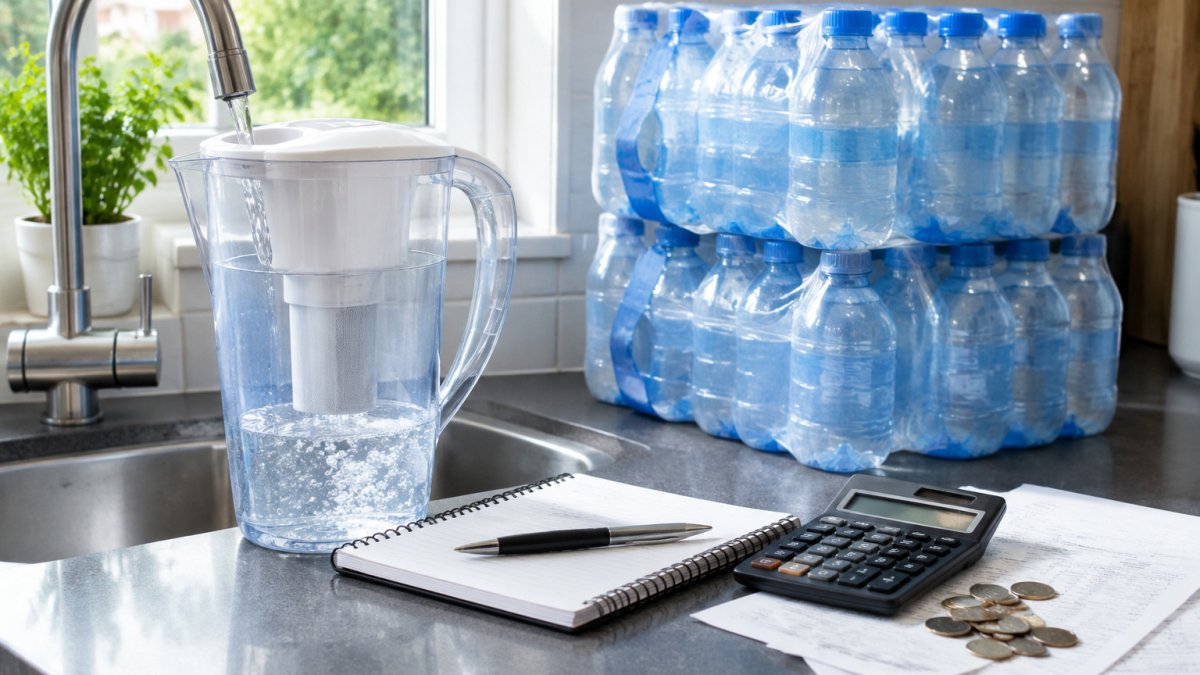
The AceBio+ 1.0 Litre Alkaline Mineral Water Filter Jug sits at the entry point, priced at £125.00. It is compact, needs no electricity or tap connection, and its filter set is rated for up to 4,800 litres or 24 months. For a single person or a couple, that cartridge life is a practical benchmark for running costs.

For a larger household, the BIO 400 5.25 Litre Bench Top Water Filter costs £329.00 and is rated for up to 12,000 litres or 18 months per filter set.

The BIO 500 MAX 7 Litre Bench Top Water Filter at £349.00 offers the same filter life with a larger 7-litre reservoir, which suits families who fill a jug several times a day.
Replacement cartridges are the running cost that matters most. Always confirm the current cartridge price on the product page before you budget, because it is the number that decides your long-term saving.
Filter Life and Cost Per Year Compared
Filter life determines how often you pay for a replacement. The table below summarises the rated figures for the Waters Co models covered . Rated life assumes typical municipal water and average daily use, so a heavy user will replace filters sooner.
| Product | Price | Rated Filter Life | Best For |
|---|---|---|---|
| AceBio+ 1.0 Litre Jug | £125.00 | Up to 4,800 litres or 24 months | One or two people |
| ♥MyWaterJug 1.5L | £64.99 | Up to 300 litres or 90 days per cartridge | Single person, low use |
| BIO 400 5.25 Litre | £329.00 | Up to 12,000 litres or 18 months | Families, home and office |
| BIO 500 5.25 Litre | £329.00 | Up to 12,000 litres or 18 months | Families, home and office |
| BIO 500 MAX 7 Litre | £349.00 | Up to 12,000 litres or 18 months | Larger households |
Price
The ♥MyWaterJug has the lowest upfront price but the shortest cartridge life, so its cost per litre over time can end up higher than the AceBio+ if you drink a lot.
How to Make Tap Water Taste Better Before You Buy Anything
Before you spend money, check the simplest causes of poor-tasting tap water. Most taste complaints come from residual chlorine, which is added to keep water safe as it travels through the pipes. Chlorine smells like a swimming pool and often disappears if you leave an open jug in the fridge for a few hours, because it evaporates (Chlorine).
Cold water usually tastes better than warm, so store filtered or tap water in the fridge rather than drinking it straight from a warm tap. Running the cold tap for a short time before you fill a glass can also clear water that has been standing in the pipes overnight.
If your water tastes earthy or metallic, the cause may be the pipework in your home rather than the supply. Flushing the system and checking for old galvanised pipes are worth doing first. A filter is the next step when these simple fixes fail.
Taste Profiles: Matching a Filter to Chlorine, Hardness and Odour
Different taste problems need different filter media, so matching the filter to the complaint matters more than choosing the most expensive model. The useful way to do this is to describe your water's taste in plain terms, then match that description to the stage that treats it.
Chlorine and swimming-pool smell. Residual chlorine is added to keep water safe as it travels through the pipes, and it is the most common cause of poor taste. Activated carbon is the stage that deals with it: the carbon surface adsorbs chlorine and many organic odours as the water passes through.
Earthy, musty or algae-like notes. These usually come from organic compounds rather than chlorine. Carbon again does most of the work, but the contact time matters: a larger filter bed with slower flow gives the carbon longer to adsorb the compounds.
Metallic or harsh taste. A metallic note often points to the pipework in your home rather than the supply, so flush the system and check for old galvanised pipes before blaming the water.
Flat or lifeless taste. Very pure water can taste flat because it lacks the minerals that give water its body. Mineral-based media can soften that flatness and help with hardness, which is the amount of calcium and magnesium dissolved in the supply. Our guide to whether mineral water filters are worth it explains how they compare on taste.
Hard water. Hardness is not a taste fault in itself, but it affects how water feels and how it behaves in a kettle (Water Hardness / Hard Water).
The ♥MyWaterJug and AceBio+ both use multi-stage filtration.
Before choosing, decide which taste bothers you most and write it down in one sentence. You can also read how to choose the right mineral filter cartridge for your water jug for step-by-step matching.
Water Filter Jug vs Bottled Water: Convenience, Quality and Environmental Cost
Bottled water wins on convenience only when you have nothing else to drink from. A filter jug needs filling and a cartridge swap every few months, but it removes the constant trips to the shop and the pile of plastic at the end of each week.
On quality, the answer depends on your local supply and your taste. Filtered water removes chlorine and many contaminants. Check each product listing for its specified removal details before you rely on them.
The environmental cost is easier to see.
Working Out Your Break-Even Point and Choosing Your Filter
Work out your break-even point by adding the filter's purchase price to the cost of its replacement cartridges over its rated life, then dividing by the litres you filter. Compare that cost per litre with your bottled water baseline from the start of this article.
Here is a simple way to run the numbers:
- Note the purchase price of the filter.
- Find the price of one replacement cartridge or filter set.
- Estimate how many litres you drink each month and divide the rated filter life by that figure to see how many months each cartridge lasts.
- Divide the cartridge price by the litres it filters to get a cost per litre.
- Compare that figure with your bottled water cost per litre.
Watch out: the rated life assumes average use. If your household drinks more than the rated litres, your cartridge costs will rise faster than the figures suggest, so calculate with your real usage.
For a single person who drinks a few litres a day, the ♥MyWaterJug is the lowest-cost entry point. For a couple or small family, the AceBio+ is a sensible middle choice. Households that fill a jug constantly will find the BIO 400 or BIO 500 more economical over time, thanks to the longer rated filter set life.
Booking Your Switch: Which Waters Co Model Fits Your Household
Choose your model by how much you drink and how much space you have. Renters with limited storage will find the portable jugs easiest to manage, while homes with a dedicated kitchen counter may prefer a bench top system.
If you drink a small amount and want the lowest upfront cost, the ♥MyWaterJug 1.5L Water Filter at £64.99 is the simplest starting point. If you want a jug with a longer filter life for two people, the AceBio+ 1.0 Litre Alkaline Mineral Water Filter Jug at £125.00 is the better fit. For larger households, the BIO 400 5.25 Litre Bench Top Water Filter at £329.00 or the BIO 500 5.25 Litre Bench Top Water Filter at £329.00 offer the longest rated life per filter set, while the BIO 500 MAX 7 Litre Bench Top Water Filter at £349.00 adds a bigger reservoir.
Whichever model you choose, run the break-even calculation above with your own bottled water spend before you buy. That single calculation will show you how quickly the switch pays for itself.
Frequently Asked Questions
Is filtered tap water cheaper than bottled water?
Yes, by a wide margin. Bottled water costs more per litre than tap water once you include packaging and retail markup. The exact saving depends on how much water you drink and which filter you buy. The exact saving depends on how much water you drink and which filter you buy, so calculating your own weekly spend is the most reliable check.
How much can you save by switching from bottled water to a water filter?
The AceBio+ 1.0 Litre Alkaline Mineral Water Filter Jug costs £125.00 and its filter set lasts up to 4,800 litres or 24 months. The BIO 400 5.25 Litre Bench Top Water Filter costs £329.00 and has a filter set lasting up to 12,000 litres or 18 months. Compare these running costs against your current bottled water spend to find your break-even point.
Does a water filter make tap water taste better?
Yes. Most taste complaints in UK tap water come from residual chlorine, and activated carbon filtration removes much of it. Waters Co filters use multi-stage filtration. Taste is personal, so the most reliable test is to run a filter for a week and compare it directly against your usual tap water.
What is the cheapest way to improve the taste of tap water?
Chilling tap water in the fridge and leaving it uncovered for a few minutes helps some chlorine dissipate. For a lasting fix, a filter jug is the lowest-cost option that changes the water itself. The MyWaterJug 1.5L Water Filter costs £64.99 and carries a filter good for up to 300 litres or 90 days, making it the entry point for households that want a clear taste improvement without a plumbed system.
