

Tap Water Safety by Country: 7 Rankings and Travel Tips
Last Updated: November 26, 2026
Quick Summary
Tap water safety by country is usually measured by access to improved water sources or environmental health scores, not by direct tests of what comes out of a tap. Treat country rankings as a starting point only, because a national average hides city, building and seasonal variation. When you cannot confirm a supply is safe, treat it as unsafe until you have better information.
- An improved water source measures infrastructure, not purity at the point you drink.
- The Environmental Performance Index draws on access to safe drinking water and sanitation, not direct tap tests.
- Nordic countries, Germany, Austria, Switzerland, Japan, Australia and Canada are commonly rated safe.
- Travel-health sources most often flag sub-Saharan Africa, South Asia, Southeast Asia and Central America.
- Boiling is effective against microbial hazards but does not remove chemical contaminants.
Table of Contents
- What Tap Water Safety Rankings Actually Measure
- Countries With Safe Tap Water: The Cleanest Rankings
- How to Read a Tap Water Safety Map
- Countries Where Tap Water Is Not Recommended
- Can I Drink Tap Water Abroad? City and Region Exceptions
- Travel Water Safety Tips When You Are Unsure
- Choosing a Portable Filter for Uncertain Water
- Check Your Destination Before You Pack
- Frequently Asked Questions
What Tap Water Safety Rankings Actually Measure
Tap water safety by country is one of the most searched travel health topics, and also one of the most misunderstood. Most rankings you will find online measure something narrower than the name suggests, which is why two credible-looking lists can contradict each other about the same destination.
Here is the distinction that matters. A water quality ranking scores the chemical and microbial state of water that reaches a household tap. An access ranking scores how many people have a piped supply at all.
Safety Scores vs Access to Improved Water Sources
An improved water source is a supply designed to protect water from outside contamination, such as a piped connection, a borehole or a protected well. The World Health Organization's drinking-water fact sheet defines the term this way, and it is a measure of infrastructure, not purity.
That gap trips up travellers constantly. A high access figure tells you the plumbing exists. It does not tell you the water is free of microbial or chemical risk at the point you drink it.
Countries With Safe Tap Water: The Cleanest Rankings
Countries with safe tap water cluster heavily in northern and western Europe, plus a handful of high-income markets elsewhere.
What the cleanest water supplies have in common is boring: modern treatment plants, well-maintained distribution networks, strict drinking-water standards and regular testing. That combination is expensive and slow to build, which is why the leaderboard changes so little year to year.
Where the Cleanest Water Supplies Cluster
The pattern is regional rather than random. Northern Europe, Australasia, Japan and Canada consistently score well. The clusters reflect investment over decades, not geography or climate. A country that upgrades treatment and pipe maintenance climbs the rankings; one that defers maintenance slowly slides.
What the Rankings Actually Reward
Before you treat a high score as a green light, it helps to know what is being measured. The EPI's water indicators draw on access to safe drinking water and sanitation, and on treated wastewater, rather than on a direct test of what comes out of a hotel tap.
A common pattern is that the highest-scoring nations combine three things: universal piped supply, treatment that includes filtration and disinfection, and a regulator that publishes test results. The Drinking Water Inspectorate is one example of a body that audits supplies and publishes compliance data, which is why its findings are worth more to a traveller than a single headline score.
Countries Commonly Rated Safe for Travellers
Among the destinations most often described as safe to drink from the tap are the Nordic countries, Germany, Austria, Switzerland, the Netherlands, Belgium, France, Ireland, Japan, Australia, New Zealand and Canada.
Treat that list as a starting point for planning, not a guarantee. For the practical checks that sit underneath the ranking, see our guide on how to test tap water for contaminants at home.
Watch out: a country can be rated safe overall while a specific region, private supply or building is under a boil-water notice, so always confirm the local position before you drink.
How to Read a Tap Water Safety Map
A tap water safety map is a colour-coded visual showing which countries are generally safe to drink from and which are not. Read it as a starting point, never a guarantee. Maps are built on national averages, and a national average hides everything happening at city and neighbourhood level.
Three habits make a map genuinely useful. First, check the publication date; a map built on data from several years ago may not reflect current treatment or infrastructure. Second, read the legend carefully, because "safe" and "safe for locals" are different claims. Third, cross-check against your specific destination city rather than the country as a whole.
Countries Where Tap Water Is Not Recommended
Tap water is not recommended for drinking in many parts of the world, generally where treatment and distribution infrastructure cannot guarantee microbial safety at the tap.
Watch out: the risk is not evenly spread within a country. If you want to understand what contaminated water does over time, our guide to the long-term health risks of drinking tap water covers the health side in detail.
Regions Most Often Flagged for Travellers
Guidance from travel-health sources most often flags parts of sub-Saharan Africa, South Asia, Southeast Asia, Central America, parts of South America, and the Middle East where supply is intermittent or treatment is limited. The common thread is not climate but infrastructure: where piped supply is intermittent, pressure drops can allow contamination to enter the network, and where treatment is inconsistent, microbial risk rises.
That said, the label is a national average.
Why Clear Water Is Not the Same as Safe Water
Microbial hazards such as bacteria, viruses and protozoa are the main traveller risk, and they are invisible. Chemical hazards, including nitrate, arsenic and lead, can also be present without any change in taste, colour or smell.
A common pattern in higher-risk settings is that the municipal supply is treated but the building's storage tank or internal pipework is not maintained, so the risk sits after the treatment plant rather than at it.
Practical Options When Water Is Unsafe or Uncertain
When you cannot confirm the supply is safe, treat it as unsafe until you have better information. Sealed bottled water is the simplest option, and it should also be used for brushing teeth where advised.
Portable filters and treatment devices bridge the gap, though it is worth being precise about what they do.
For destination-specific reading, see our guide to portable water filters for travel and active lifestyles.
Can I Drink Tap Water Abroad? City and Region Exceptions
Yes, often, but the answer depends on the city and sometimes the building. This is the single biggest gap in country-level rankings: they cannot see street-level variation.
Common exceptions to know:
- Capital versus rural: treatment quality often differs sharply between a capital and outlying regions.
- Older buildings: internal plumbing, storage tanks and lead pipework can affect water quality even where the municipal supply is sound.
- Seasonal events: heavy rain, flooding or treatment failures can trigger short-term boil-water notices.
Check local advisories at your destination, not just the national picture. If you want certainty about your own supply at home, our guide on how to test tap water for contaminants at home walks through the practical options.
Travel Water Safety Tips When You Are Unsure
When you are unsure about a destination's water, treat it as unsafe until you have better information. That is the simplest rule, and it holds up better than trying to research every neighbourhood.
A practical checklist for uncertain water:
- Confirm the current advisory with your accommodation and local authority on arrival
- Drink bottled or filtered water, and use it for brushing teeth if advised
- Skip ice in drinks unless you know it is made from safe water
- Avoid raw salad and fruit you cannot peel in higher-risk areas
- Carry a portable filter so you are not dependent on bottled water
- Keep a backup supply for travel days and delays
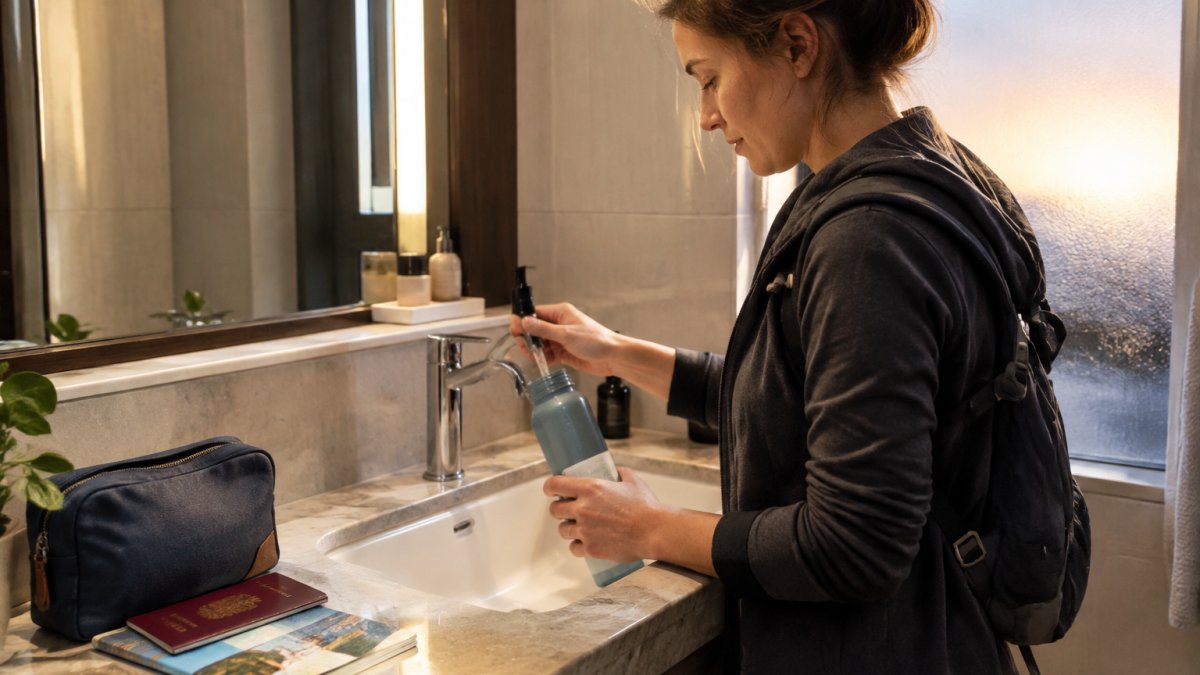
The woman is British.
For deeper destination-specific reading, see our guide to portable water filters for travel and active lifestyles.
Choosing a Portable Filter for Uncertain Water
A portable filter is the practical answer to uncertain water, and the choice comes down to how you travel and how much you need to filter. Gravity-fed bench top systems suit a fixed base; bottles and jugs suit movement.
Our range covers both ends. The Mini BMP Waterman 600ml Black at £49.99 is a portable bottle that filters up to 300 litres, removes up to 99% of fluoride using nano activated carbon, and needs no electricity or tap connection. For a family base, the bench top filter collection includes the BIO 400 at £329.00, a 5.25 litre gravity system with 13 stages of filtration and a filter set lasting up to 12,000 litres or 18 months.
| Option | Price | Capacity | Filter Life | Best For |
|---|---|---|---|---|
| Mini BMP Waterman 600ml | £49.99 | 600ml | Up to 300 litres | Travel, gym, hiking |
| ♥MyWaterJug 1.5L | £64.99 | 1.5 litres | Up to 300 litres | Fridge and desk use |
| AceBio+ 1.0L Jug | £125.00 | 1.0 litre | Up to 4,800 litres | Small households |
| BIO 400 Bench Top | £329.00 | 5.25 litres | Up to 12,000 litres | Family home base |
Price
Best for: travellers who want filtered water without relying on bottled supplies. Skip if: you only need occasional filtering and a jug filter already meets your needs.
Check Your Destination Before You Pack
Rankings are useful, but they are a starting point, not a verdict.
At Waters Co, we have spent over 40 years building filtration systems that turn uncertain tap water into clean, alkalised, mineral-rich drinking water.
Before your next trip, sort your water supply rather than hoping for the best. Browse the BIO 400 bench top filter and see how a gravity system keeps your whole household supplied with cleaner, better-tasting water.
Frequently Asked Questions
Which countries have the safest tap water?
Countries that consistently score highest for drinking-water quality and treatment infrastructure include Iceland, Finland, Norway, Sweden, Denmark, Switzerland, Austria and the Netherlands. These places combine protected source water, widespread water treatment and strong drinking-water standards. A high tap water safety score is a country-level average, though, so it does not guarantee every building or rural supply on your route meets the same level. Check local advisories for the specific area you are visiting.
How can I check whether tap water is safe to drink in a country?
Start with your destination's national drinking-water regulator or health ministry, which publishes quality data and any boil-water notices. Cross-check with a current tap water safety map and official travel health guidance. Look for three things: whether the supply is treated to drinking-water standards, whether there are active advisories, and whether local people drink it. If those sources disagree or the information is out of date, treat the water as uncertain and use a filter or bottled water.
Can a water filter make unsafe tap water safe?
It depends on what is in the water and what the filter is rated to remove. A carbon-based jug or bench top filter can cut chlorine, taste and odour, heavy metals and some chemicals, which improves water that is already microbiologically safe. It is not a guarantee against bacteria, viruses or a boil-water notice. When a supply is genuinely unsafe, boiling or an appropriate purification method comes first, and filtration is a secondary step for taste and chemical reduction.
Does safe tap water mean it is free from all contaminants?
No. Safe to drink means the water meets legal limits for a defined list of contaminants, not that it contains none. Trace amounts of chlorine, minerals, and in some supplies fluoride or residual treatment chemicals can remain within permitted levels. That is why some households filter water they know is safe: to reduce chlorine taste, sediment and trace chemicals such as forever chemicals, and to add minerals. Compliance with standards and personal preference are two different questions.
What should I do if tap water is not safe to drink?
Use sealed bottled water from a reputable source, or boil tap water for at least one minute if you can and it is only a microbiological concern. Avoid ice, and brush your teeth with safe water rather than the tap. For longer stays, a portable filter bottle such as the Mini BMP Waterman 600ml (£49.99) lets you filter tap water as you go, removing up to 99% of chlorine, heavy metals and bacteria. Always follow local boil-water notices first.
