

How to Verify Water Filter Lab Testing: 2026 Guide
Table of Contents
- Why Water Filter Lab Testing Claims Need Independent Verification
- Accredited Water Testing: What It Means and Why It Matters
- Water Filter Standards Explained for UK Buyers
- How to Read Water Quality Lab Reports Without a Science Degree
- Step-by-Step: How to Verify Water Filter Lab Testing Before You Buy
- Red Flags in Lab Reports and Contaminant Removal Claims
- DIY vs Professional Lab Testing: What Each Method Can and Cannot Prove
- Frequently Asked Questions
Last Updated: September 11, 2026
Why Water Filter Lab Testing Claims Need Independent Verification
Anyone can print "99.9% contaminant removal" on a box. Proving it is another matter. Learning how to verify water filter lab testing means checking who tested the product, which contaminants were measured, and whether the numbers apply to your tap water. We've spent four decades watching this gap between marketing and evidence.
The stakes are not abstract. Filtration claims drive purchases by families trying to reduce exposure to heavy metals, VOCs, and microplastics. When those claims rest on in-house testing rather than third-party validation, you have no independent way to confirm them.
Below, we'll show you how to check accreditation, read a lab report, and spot the red flags that separate certification from clever wording.
Accredited Water Testing: What It Means and Why It Matters
Accredited water testing is analysis carried out by a laboratory assessed against ISO/IEC 17025 and formally recognised for that specific test method (iso.org). Accreditation is a scope, not a one-off badge, and the scope matters more than the logo.
Here's the part most buyers miss: a lab can be accredited for one method and not another. A lab approved for microbiological testing is not automatically approved for trace heavy metals. If a report does not name the specific method and accreditation number, treat the result as unverified.
Water Filter Standards Explained for UK Buyers
Water filter standards explained simply: consensus standards defining how a filter must be tested for contaminant reduction, material safety, and structural integrity. The two you will see most often are standards for aesthetic effects like taste and odour, and those for health-related contaminants.
A product certified to a health-related standard has had its contaminant removal claims tested against a defined protocol by an accredited body, stronger than a manufacturer's own bench test (nsf.org).
Watch the standard number, not the badge. Certification for aesthetic effects says nothing about lead or PFAS removal. Many products display a certification mark prominently while the certified claims cover only taste and chlorine.
Tested To vs Certified By: The Distinction That Changes Everything
"Tested to" means a sample was run against a standard's method, often by the manufacturer or a lab it chose. "Certified by" means an accredited certification body reviewed the test data, audited production, and stands behind the claim. Only the second gives independent verification and ongoing surveillance.
If a product page says "tested to standards" without naming a certification body, you have a test result, not a certification. Ask for the certificate.
The distinction maps onto real differences in legal exposure and ongoing obligation:
- Who carries the liability. With a test, the manufacturer owns the claim and any consequence of it being wrong. With a certification, the certifying body has reviewed the evidence and can be held to its published scope.
- Whether surveillance continues. Certification schemes include periodic factory inspections and market sampling. A one-off test describes a single batch on a single day.
- Whether the scope is public. A certification listing states the exact model, standard, and contaminants covered, checkable against the certifier's public database. A test report is a private document the manufacturer may summarise however it chooses.
- Whether the claim is enforceable. Certification marks are protected, and misuse is something a certifying body can act on. There is no equivalent consequence for "tested to".
A useful test of your own: ask the supplier for the certificate number and the certifying body's name, then look both up independently. If the certificate names the company but not the specific model, it does not cover the product you are considering. Certifications are model-specific.
Aesthetic Claims vs Health-Critical Claims
Not all contaminant claims carry the same weight. Aesthetic claims, taste, odour, chlorine reduction, fall under certain standards and are relatively easy to demonstrate. Health-related claims, lead, PFAS, VOCs, microbiological reduction, fall under other standards and require more demanding protocols and lower detection limits.
When you compare products, sort the claims into the two buckets. A filter may hold a strong aesthetic certification and no health certification at all, while its packaging leads with a health-adjacent image. The standard number tells you which bucket a claim sits in; the badge alone does not.
How to Read Water Quality Lab Reports Without a Science Degree
The skill is knowing which four or five fields carry the weight, and which patterns signal data that has been shaped rather than measured.
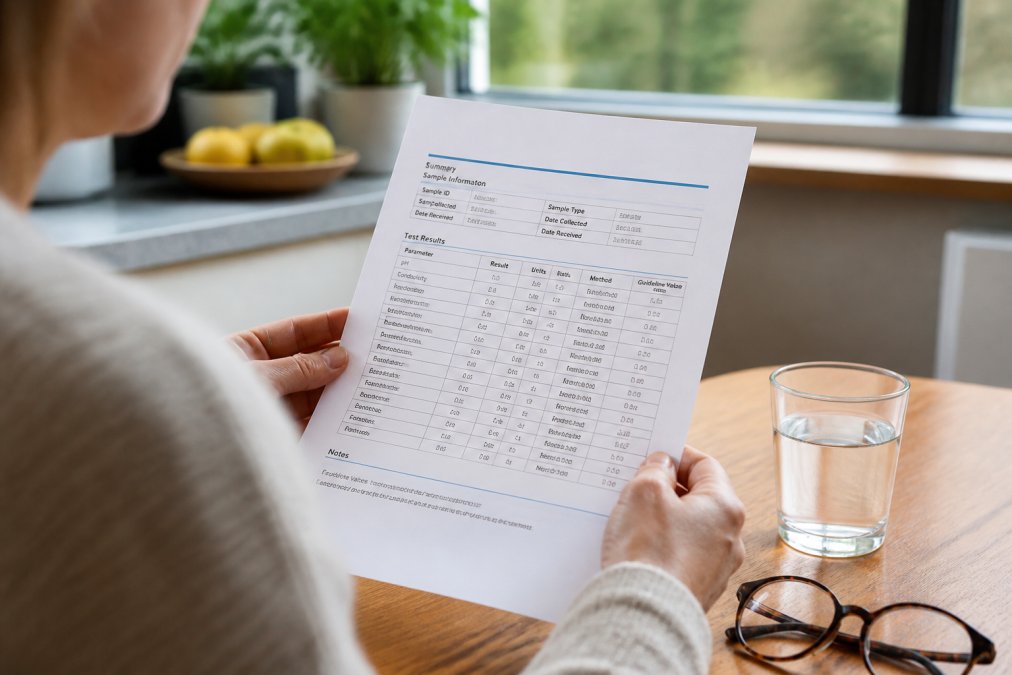
Check these fields first:
- Laboratory name and accreditation number, verify lab
- Sample date and report date, stale data tells you little about current production
- Method reference, the specific standard or in-house method used
- Detection limit, the smallest concentration the method can reliably measure
- Result units, mg/L, µg/L, or ppm; mismatched units hide weak results
A result reported as "not detected" is only meaningful alongside the detection limit. If the limit is higher than the health-based guidance value, "not detected" proves very little. A lab reporting "not detected" for lead at a detection limit of 5 µg/L has told you almost nothing.
Reading the Report Critically: Spotting Lab Shopping and Shaped Data
Most guides stop at "find the report." The harder skill is judging whether the report in front of you is the best of many attempts or the honest output of a single, pre-registered test.
Lab shopping is commissioning the same test from several laboratories and publishing only the most favourable result. It is hard to prove from a single document, but it leaves fingerprints:
Shop Now For Certified Quality Filtration →
- No sample chain-of-custody record. A credible report names who drew the sample, when, and how it was sealed and transported. If the manufacturer supplied the sample with no independent collection, the result describes that one sample, not the product line.
- A single test run with no repeat or duplicate. Reputable protocols run duplicates and spiked samples to demonstrate the method is performing. Absence of quality-control data is a warning sign.
- Suspiciously round or favourable numbers. A reduction figure of exactly 99.9% across every contaminant, with no variance between runs, is more consistent with a summary graphic than a raw analytical report.
- A different laboratory named on each claim. If the lead claim cites one lab, the PFAS claim another, and the microplastics claim a third, ask why a single accredited method was not used throughout.
- Method substitution. A report may state it used an "in-house method" rather than a published standard. In-house methods are not inherently invalid, but they cannot be compared against a recognised protocol and are rarely within an accreditation scope.
Manipulated or selectively presented data is subtler. Watch for results quoted at a favourable challenge concentration rather than a realistic one, or reduction percentages calculated against an influent level far higher than any real supply would contain. A filter removing 99% of a contaminant from water spiked at ten times the regulatory limit may remove far less at the concentrations you actually encounter.
A report is evidence only if you can trace the sample, the method, the laboratory's accreditation scope, and the raw result. If any of those four links is missing, you are reading a claim, not a test.
Micron Ratings, Flow Rates and What the Numbers Actually Tell You
A micron rating is the nominal particle size a filter is designed to capture, expressed in micrometres. A 1-micron rating captures particles of roughly that size and larger; a 0.2-micron rating captures finer material, including many bacteria and some microplastics.
Two cautions. First, nominal ratings are not absolute; a filter rated "1 micron nominal" may pass a meaningful share of particles at that size. Second, micron rating says nothing about dissolved contaminants. Lead, fluoride, and PFAS are dissolved, so they are removed by adsorption media or ion exchange, not physical screening.
Flow rate matters for a different reason. A filter pushed beyond its rated flow rate has less contact time with the media, and contaminant reduction can drop below the tested figure. If a system claims a reduction rate at 2 litres per minute, running it at 4 litres per minute invalidates that claim in practice.
Step-by-Step: How to Verify Water Filter Lab Testing Before You Buy
Here is the sequence we recommend, taking about fifteen minutes per product.
- Find the certification mark and the standard number. Note whether it is a standard for aesthetic effects, health-related contaminants, or another type, and which contaminants it covers.
- Search the certifying body's public listing. Confirm the model number appears, and check the certification is current rather than withdrawn.
- Request the full laboratory report, not a summary graphic. Legitimate manufacturers provide it on request.
- Check the laboratory's accreditation including the specific test method.
- Compare the tested contaminant list against your actual water quality concerns, using your supplier's water quality analysis as a baseline.
- Confirm the tested flow rate and filter life match how you intend to use the system.
- Look for post-filtration results, not just pre-filtration baseline testing. The number that matters is what leaves the filter.
Verification Step |
What You Are Checking |
Where to Look |
|---|---|---|
Certification mark |
Standard number and scope |
Product packaging or manual |
Certifying body listing |
Model number is current |
Certifier's public database |
Full lab report |
Methods, limits, dates |
Request from manufacturer |
Lab accreditation |
Method is within scope |
Accreditation directory |
Flow rate and life |
Matches your usage |
Performance data sheet |
A common mistake is accepting a certificate that names the company but not the specific model. Certifications are model-specific. If the model number on the certificate does not match the product in your hand, the certification does not apply to it.
Red Flags in Lab Reports and Contaminant Removal Claims
The most reliable warning sign is vagueness. A report listing contaminant removal claims without naming the analytical method, detection limit, or accrediting body is not evidence, it is marketing with numbers attached.
Other patterns worth treating with suspicion:
- A single composite sample presented as representative of all units
- No detection limits stated, which makes "not detected" meaningless
- Results dated years ago with no retest, despite changes in filter media or supply chain
- Accreditation claimed for the company rather than the laboratory, which are different things
- Contaminant reduction claims for substances the standard does not cover
If a supplier cannot produce a report with a named laboratory, a method reference, and a date, that is your answer.
DIY vs Professional Lab Testing: What Each Method Can and Cannot Prove
Home test strips are useful for a rough baseline. They flag obvious issues with pH, hardness, or chlorine, and are cheap enough to use repeatedly. What they cannot do is measure trace heavy metals or VOCs at the concentrations that matter for health, because their detection limits are far too high.
Professional analytical testing uses instrumentation such as inductively coupled plasma mass spectrometry for metals and gas chromatography for volatile organics, reaching detection limits home kits cannot approach.
The practical split: use home testing for a rough baseline and to monitor obvious changes. Commission professional testing when you need to verify a contaminant removal claim, investigate a specific concern, or establish a defensible record. For verifying a filter's performance claims, only accredited laboratory analysis carries weight.
Our systems are built around multi-stage filtration including submicron filtration and ion exchange, and we publish the testing behind our contaminant reduction claims so you can check the methodology rather than take our word for it.
Verifying filtration claims takes patience, but the alternative is trusting a number someone printed on a box. Start with the certification scope, confirm the laboratory's accreditation, and read the detection limits before the headline figure. If you want a system whose performance data you can inspect, explore the Waters Co range: multi-stage filtration, long-life filters, and testing documentation you can review before you buy. Make your next purchase an evidence-based one.
Frequently Asked Questions
How can I verify the authenticity of a laboratory report for a water filter?
Check the report includes the laboratory's UKAS accreditation number, the specific test methodology used, and the date of testing. Contact the laboratory directly using contact details from the UKAS website, not from the report itself. Ask them to confirm the report reference number matches their records. Legitimate labs will verify reports without hesitation. If a company cannot provide the original report or the lab cannot confirm it, treat the contaminant removal claims as unverified.
What accreditation should a water testing laboratory hold in the UK?
A laboratory testing drinking water in the UK should hold UKAS accreditation to ISO/IEC 17025 for the specific tests performed. UKAS is the national accreditation body, and ISO/IEC 17025 confirms the lab meets international standards for testing competence. Check the UKAS website to confirm the laboratory's accreditation is current and covers the exact contaminants being tested, such as heavy metals, volatile organic compounds, or PFAS.
What is the difference between NSF certification and independent lab testing?
NSF certification means an independent organisation has tested a filter against specific NSF/ANSI standards and regularly audits ongoing production. Independent lab testing, by contrast, tests a sample at a single point in time. A lab report shows how one unit performed on one day; certification confirms every unit made to that specification meets the standard. For full confidence, look for both: certification to relevant NSF/ANSI standards and current lab reports confirming performance data.
How do I check if my water filter is effectively removing contaminants?
Request a post-filtration lab report from the manufacturer showing contaminant reduction percentages for the specific filter model. Cross-reference the test methodology against NSF/ANSI standards. Check that the report lists the exact contaminants you want removed, such as fluoride, heavy metals, or microplastics, with measured reduction figures. If you want independent confirmation, send a filtered water sample to a UKAS accredited laboratory for baseline testing and compare results against your unfiltered tap water.