

Why Switch from Bottled Water to Filtration in 2026
Table of Contents
- Bottled Water vs Filtration: The 2026 Comparison Table
- The Cost of Bottled Water vs Home Filtration: Long-Term Savings
- Environmental Impact of Plastic Bottles UK: Waste and Carbon Footprint
- How to Remove Microplastics from Tap Water at Home
- Hidden Chemicals in Plastic Bottles: Leaching and Contaminant Removal
- Taste, Odour, and Hydration: The Everyday Benefits of Filtered Water
- Choosing a Filtration System: Types, Installation, and Upkeep Costs
- Conclusion: Making the Switch to Filtered Water
- Frequently Asked Questions
Last Updated: September 13, 2026
Bottled Water vs Filtration: The 2026 Comparison Table
Switching from bottled water to filtration is the practice of replacing single-use plastic bottles with a home system that treats your municipal water supply at the point of use. At Waters Co, we have spent four decades refining that switch for households across the country, and the case has never been stronger.
The table below sets out the trade-offs most buyers care about.
| Factor | Bottled Water | Home Filtration |
|---|---|---|
| Cost model | Pay per bottle, forever | Upfront unit, periodic filters |
| Environmental impact | Plastic waste and transport emissions | Waste reduction, no bottle logistics |
| Contaminant removal | Varies by brand and source | Engineered multi-stage removal |
| Microplastics | Documented in bottled samples | Reduced at point of use |
| Taste and odour | Inconsistent | Chlorine and odour neutralisation |
| Convenience | Buy, carry, store | On tap, unlimited |
The rest of this guide explains where bottled water falls short, how filtration technology works, and how to match a system to your water quality rather than to marketing copy.
The Cost of Bottled Water vs Home Filtration: Long-Term Savings
The cost of bottled water versus home filtration comes down to repetition. A bottle is a single-use purchase; a filter is a capital cost spread across years of drinking water.
A common approach is to total your household's weekly bottle spend and multiply it across twelve months, then compare that figure against a system's purchase price plus replacement filters. For most families, the bottle figure compounds while the filter figure stays flat. Long-term savings come from that gap, not from any single discount.
Waters Co systems range from the £64.99 ♥MyWaterJug 1.5L Water Filter through to the £329 BIO 400 5.25 Litre Bench Top Water Filter, with long-life filters designed to last up to two years. Run the arithmetic on your own consumption before you decide.

Environmental Impact of Plastic Bottles UK: Waste and Carbon Footprint
The environmental impact of plastic bottles centres on two separate burdens: the waste stream they create and the carbon footprint of getting each bottle to your fridge. Every bottle you remove from your routine removes both, but they behave differently and are worth understanding separately.
The waste burden. A single-use bottle is designed to be used once and then managed (Single-use plastics bans and restrictions). In practice, a meaningful share never re-enters a recycling loop. Collection and reprocessing infrastructure varies by local authority, so the same bottle may be recycled in one area and landfilled or incinerated in another. According to WRAP's UK Plastics Pact progress reporting, plastic packaging remains one of the hardest material streams to recycle consistently, largely because that infrastructure is uneven. That variability is exactly why reduction beats recycling as a first move: you cannot control what happens to a bottle after the bin, but you can stop creating it.
The carbon burden. Bottled water carries emissions at every stage, extracting or treating the source water, moulding the bottle, filling and sealing it, refrigerating it through distribution, and transporting a product that is roughly 90% water by weight. Filtered tap water skips the bottling plant, the refrigerated distribution and the retail shelf space entirely. The waste reduction is the visible benefit; the carbon footprint reduction is the quieter one, and it compounds with every bottle you stop buying.
Why the two burdens diverge. Waste is a local problem with a local fix, better kerbside collection, deposit return schemes, improved sorting. Carbon is a global problem that no amount of recycling solves, because recycling a bottle still requires collection, transport and reprocessing energy. This is the core argument for switching rather than recycling harder: filtration removes the bottle from the equation instead of trying to manage it after the fact.
What this means in practice. If your household gets through, say, two litres of bottled water a day, that is roughly 730 litres a year, the equivalent of several hundred single-use bottles depending on size. Replacing that with a bench top or jug filter removes those bottles from the waste stream and the associated transport emissions in one move, without changing how much water you drink.

How to Remove Microplastics from Tap Water at Home
Microplastics in drinking water are small polymer fragments that pass through conventional treatment. Removing them at home requires filtration fine enough to capture particles at the submicron scale.
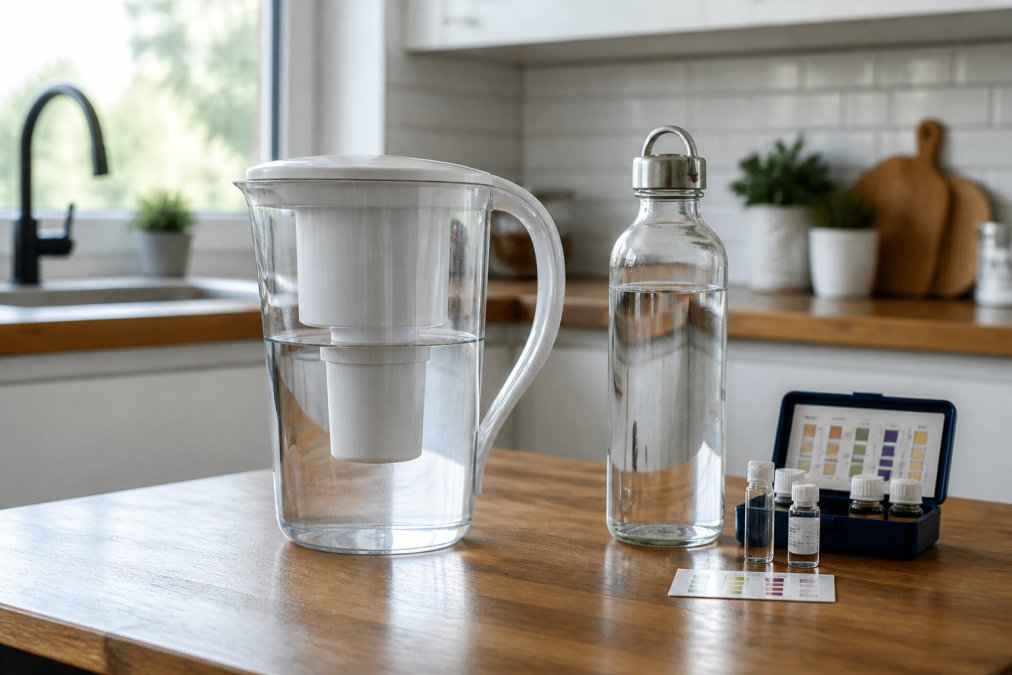
Here is how to remove microplastics from tap water at home:
- Check your local water quality report to understand your starting point
- Choose a system rated for submicron filtration rather than basic sediment removal
- Confirm the filter media includes activated carbon for chemical impurities
- Replace cartridges on schedule, since spent media releases what it captured
- Retest annually, especially if your supply source changes
Waters Co's multi-stage systems combine submicron filtration with ion exchange and activated carbon, and the brand states removal of up to 99.9% of contaminants including microplastics. Ask any supplier for third-party lab testing before you buy; a claim without documentation is just a claim.
Hidden Chemicals in Plastic Bottles: Leaching and Contaminant Removal
Leaching is the migration of chemical compounds from plastic packaging into the liquid it holds, and it is the least discussed argument for switching. Heat and time accelerate it.
Bottles stored in warm conditions, whether in a delivery van or a car boot, are the worst case. The chemicals of concern include plasticisers and other additives used in bottle manufacturing. Contaminant removal at the tap sidesteps the packaging question entirely.
This is where a home filtration system earns its place. Rather than trusting a bottle's material specification, you control the final stage of your own water purification and know exactly what media your water passes through.
Taste, Odour, and Hydration: The Everyday Benefits of Filtered Water
Taste and odour are the benefits people notice first, and they are also the ones most often explained badly. The mechanism matters, because it tells you which filter will actually fix your water and which will not.
Why tap water tastes the way it does. Chlorine is the standard disinfectant in municipal supply, and it is effective at its job, it keeps water microbiologically safe as it travels through the network (Chlorine). The problem is that chlorine and its reaction by-products, such as chloramines and trihalomethanes, carry a distinctive medicinal or swimming-pool note that many people find unpleasant at the glass. Odour is closely linked: much of what you perceive as 'taste' is actually aroma, which is why water that smells of chlorine tastes of it too.
What activated carbon actually does. Activated carbon works by adsorption. Its surface is riddled with microscopic pores, giving a single gram an enormous surface area. Chlorine, chloramines, many organic compounds and the chemicals responsible for earthy or musty odours bind to that surface as water passes through. This is why carbon is the workhorse for taste and odour, and why a filter jug or bench top gravity system, both carbon-based, can transform the drinking experience even though they do not remove dissolved minerals.

What carbon does not fix. Carbon is not a descaler. If your water is hard, the chalky mouthfeel and the scale on your kettle come from dissolved calcium and magnesium, which carbon leaves in place. Hard-water households often need ion exchange or reverse osmosis to address that, which is a different problem from taste. Knowing the distinction stops you buying the wrong system.
The hydration link. Consistent hydration is easier when water tastes good, this is the one place where the everyday benefit and the health benefit genuinely overlap. Health-conscious households commonly report drinking more water once the chlorine note is gone, simply because reaching for the tap becomes pleasant rather than a chore. That behavioural shift, not any exotic property of filtered water, is the real hydration gain.
A note on alkalised and remineralised water. For athletes and fitness enthusiasts, water that remineralises rather than strips everything out can support hydration and physical recovery better than flat, demineralised alternatives, because you are replacing some of what you lose through sweat. Alkalised water, however, is a contested category, treat recovery claims with appropriate scepticism and focus on what is measurable: you drink more water when it tastes better, and you drink more when it is always available on tap.
Choosing a Filtration System: Types, Installation, and Upkeep Costs
Choosing a filtration system is a matching exercise: your water quality, your housing type, and your tolerance for upkeep all narrow the field.
Reverse osmosis forces water through a semi-permeable membrane and removes a very broad spectrum of dissolved solids, including heavy metals and much of the total dissolved solids content. It also strips beneficial minerals, which is why remineralisation stages exist. Activated carbon is the workhorse for chlorine, taste and odour. Gravity-fed systems need no plumbing at all.
Installation complexity varies by housing type. Under-sink units require a plumber and landlord permission; bench top and jug systems require neither, which is why renters gravitate to them.
Maintenance is the cost competitors gloss over. Budget for filter replacements on a fixed schedule and check whether cartridges are proprietary.
| System Type | Installation | Best For | Upkeep |
|---|---|---|---|
| Filter jug | None | Renters, small households | Frequent cartridge swaps |
| Bench top gravity | None | Families, no plumbing | Periodic filter changes |
| Under-sink | Plumber required | Homeowners | Annual cartridge service |
| Reverse osmosis | Plumber, space needed | Hard water areas | Membrane plus pre-filters |
Waters Co's range covers the first two categories directly, including the £125.00 AceBio+ 1.0 Litre Alkaline Mineral Water Filter Jug and the £49.99 Mini BMP Waterman 600ml Black for portable use. The brand backs its products with a lifetime warranty and reports 67,000+ customers across 40+ years.
Conclusion: Making the Switch to Filtered Water
The hardest part of leaving bottled water behind is not the decision, it is finding a system that fits your kitchen, your water and your budget without a plumbing project.
Waters Co builds multi-stage filtration systems that remove up to 99.9% of toxins including fluoride, chlorine and microplastics, alkalise and remineralise with essential minerals, and use long-life filters lasting up to two years, all covered by a lifetime warranty.
Get started with Waters Co and turn your tap into a cleaner, better-tasting supply you no longer have to carry home.
Frequently Asked Questions
Is it better to have bottled water or filtered water?
Filtered water is generally better for daily use. It removes contaminants like chlorine, heavy metals, and microplastics while keeping essential minerals. Bottled water often sits in plastic for months, which can lead to chemical leaching and adds to plastic waste. A home filtration system also costs far less per litre over time. For most households, a multi-stage filter jug or bench top system provides cleaner, better-tasting water with less environmental impact.
How much money can you save by switching to a home water filtration system?
Switching to a home filtration system can save hundreds of pounds annually. Bottled water typically costs around £1 per litre, so a family drinking 2 litres each per day could spend over £700 a year. A filter jug like the AceBio+ at £125 with long-life filters lasting up to 2 years brings the cost per litre down significantly. The exact savings depend on your household size and the system you choose.
Does filtered water remove microplastics and forever chemicals?
Yes, quality filtration systems can remove up to 99.9% of microplastics and PFAS (forever chemicals). Look for systems with submicron filtration and activated carbon. Reverse osmosis also removes these contaminants but strips beneficial minerals. Gravity-fed alkaline systems like those from Waters Co use multi-stage filtration to capture microplastics while remineralising the water. Always check third-party lab testing to verify removal rates.
What are the downsides of drinking filtered water?
The main downside is the upfront cost of a system and remembering to replace filters on schedule. Some filtration methods, like reverse osmosis, remove beneficial minerals like calcium and magnesium. However, alkaline and mineral-added filters solve this by remineralising the water. Another consideration is installation for under-sink systems, though portable jugs and bench top models require no plumbing. Overall, the benefits outweigh the drawbacks for most households.